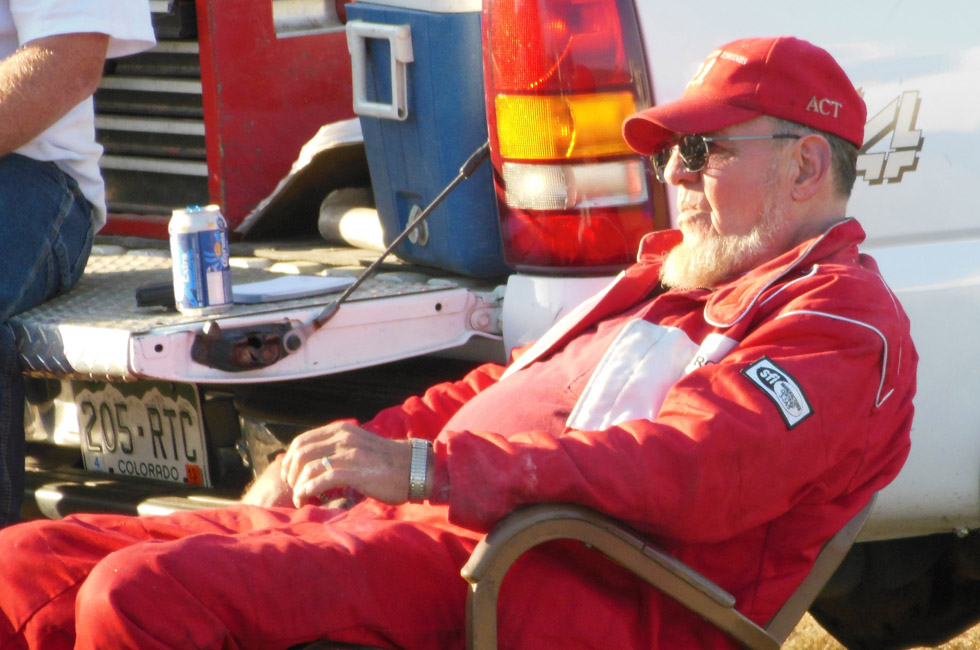
BILL SCHMITT

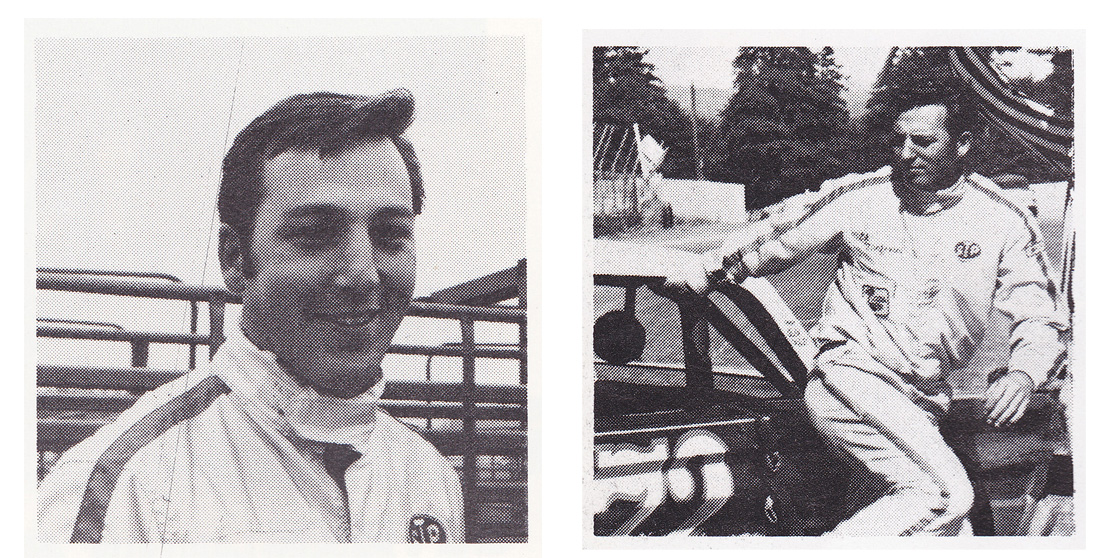
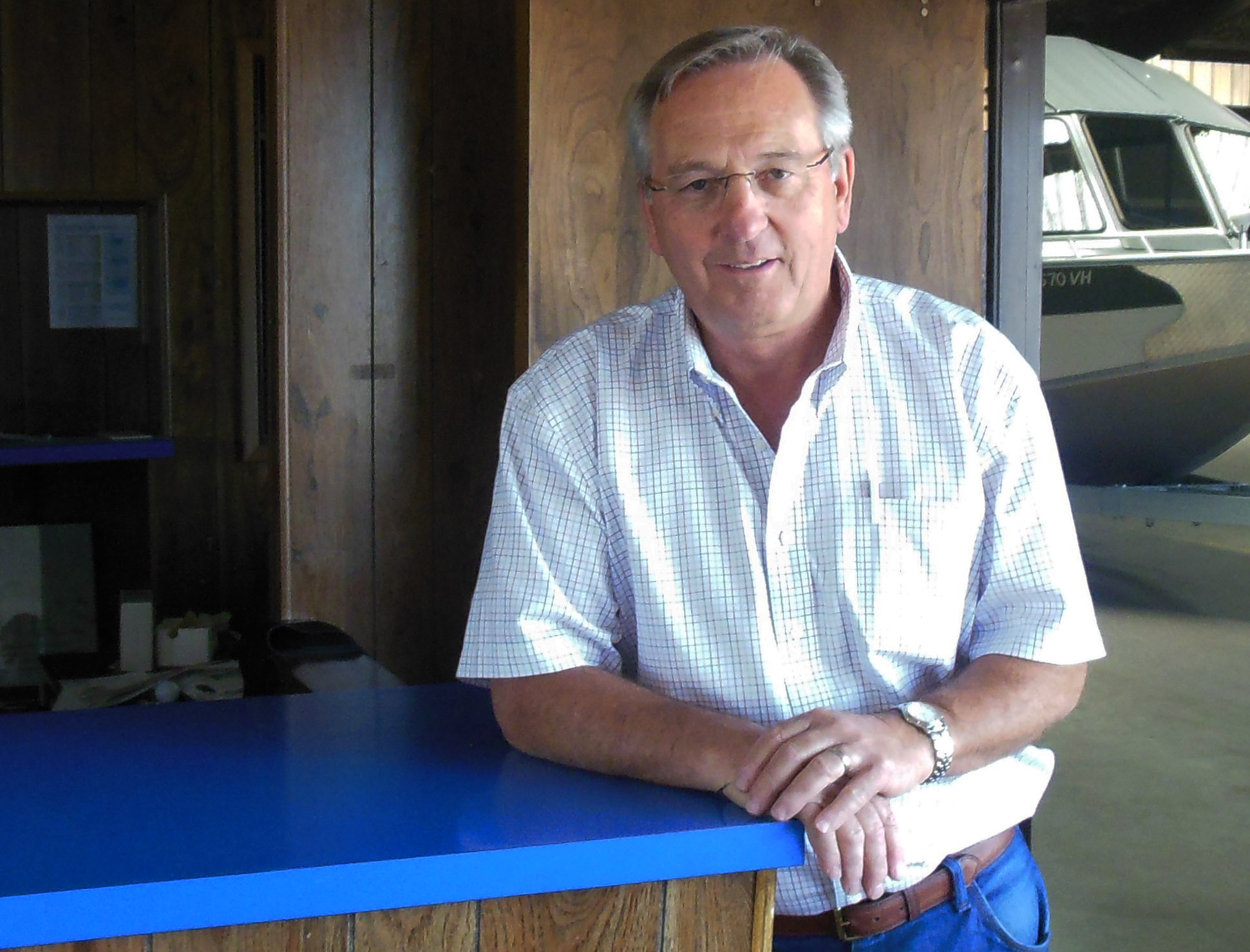
Bill Schmitt of Redding, California, was an equally successful businessman and stock car driver.

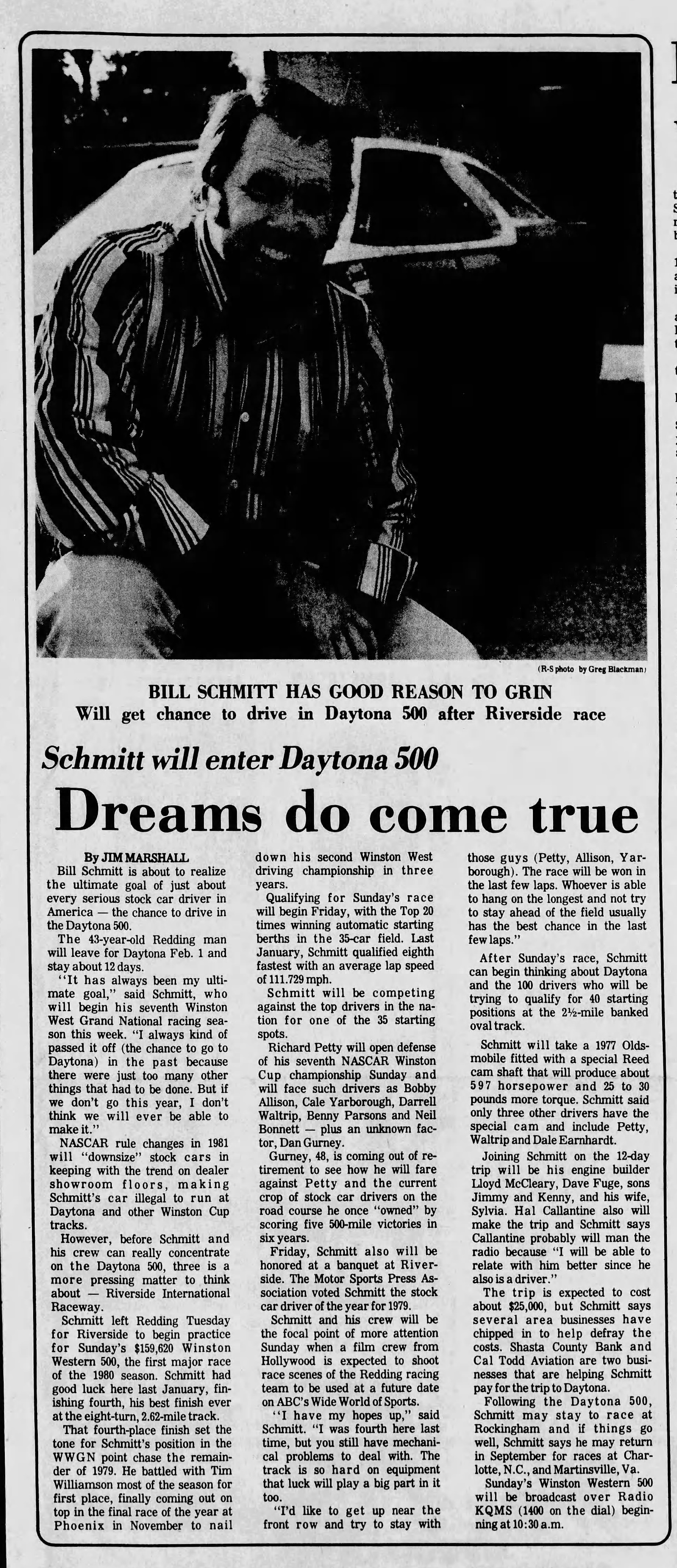
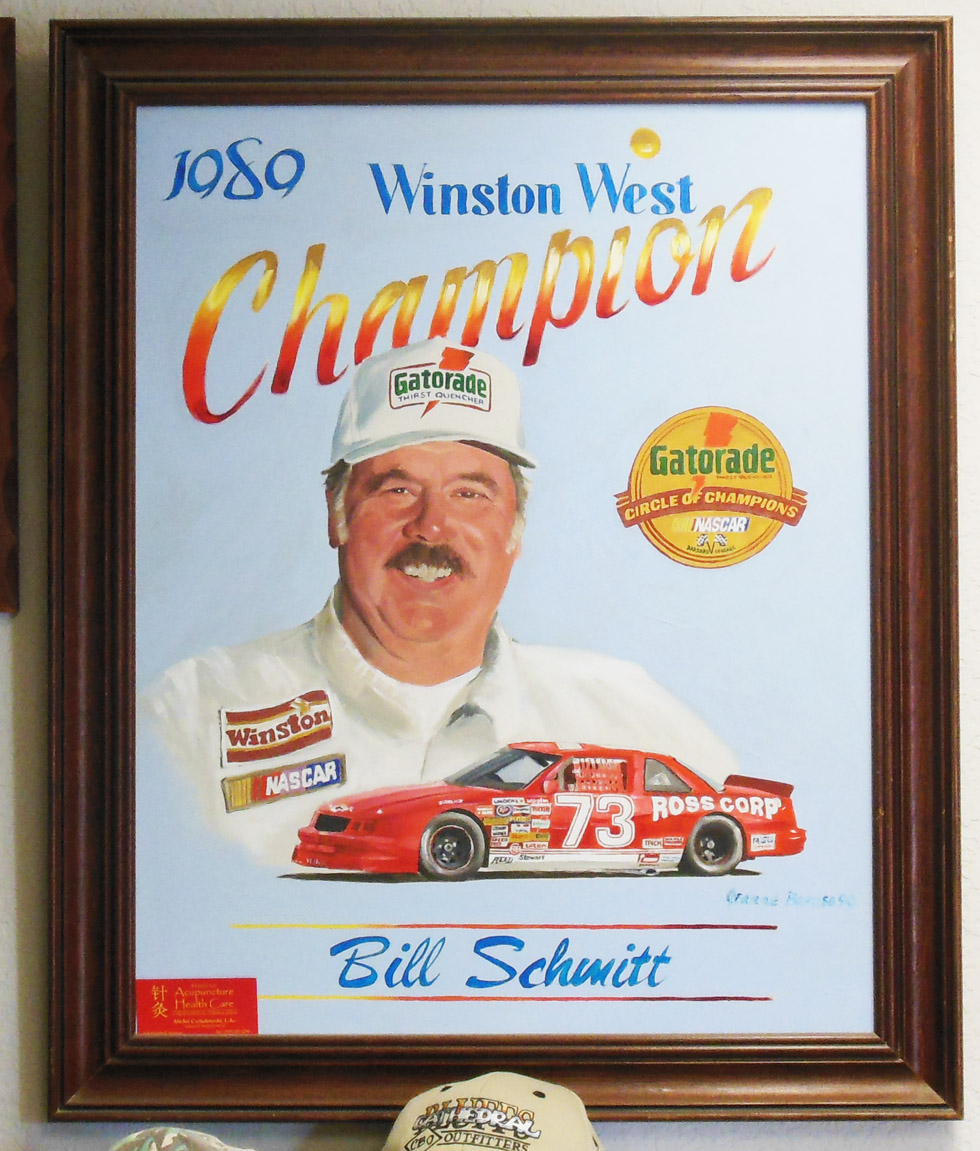
Schmitt was a four-time NASCAR Winston West Series champion (1977, 1979, 1989 and 1990), racing in the series for 20 seasons, from 1974 to 1993, which included 237 races, 19 wins and garnering 24 poles, 122 top-five finishes, 163 top-10 finishes and 4,274 laps led. He drove for legendary NASCAR driver and owner Junior Johnson.

Bill was a major figure in short track races, including on dirt at Redwood Acres Raceway in Eureka, CA, where he was a frequent and popular winner, including the historic 1978 Open Competition event.

Bill passed away in November 2014 at the age of 78. I interviewed Bill in the office of his trucking company in Redding, CA in October 2013.

EARLY DAYS AT SHASTA SPEEDWAY

Bill Schmitt:

“I was born in Fullerton, California. Went to Anaheim High School in ’56. We moved up here to the Redding area. Too crowded down there. Lived on a ranch up here for about five years, my dad and I, and finally had come down here to Redding and bought this place in the ’60s. Been here ever since.”

Bill’s early trucking business in Shasta County connected him with his first race car, leading to a lifelong passion for the track which started on the oval in Anderson, California, Shasta Speedway.

“I was drag racing in Santa Ana, come up here to Redding, and I put everything away because I had to make a living. I had four kids and thought I need to try to do something to keep things going, you know? So I got involved in the woods and stuff like that. But after about five years, I kind of got into doing my own thing, had some smaller trucks I was operating myself. This guy was working for me and all of a sudden got a call and had to move back to Colorado. And in the meantime he’d been driving and had an old Pontiac race car he built. You put one set of tires on and it would last a month, and I think in those days a new tire was maybe 25, 30 bucks, a big deal. And he had our trucking name, my name, all over his car and everything. So when he had to move, he said, ‘Here, Bill, you can just take the car, I can’t take it with me.’ So it sat around here for about a year. Finally, I thought I’d go down Anderson to try it out. What a joke I was. I ran into everything and wrecked it, blew it up every week.”

“So I sat it out for about a half a year, and watched old Jim Boyd. He was just winning every night. He’d go to Chico and race on the way to Anderson [the Valley Auto Racing Association]. And so I built a Chevy and then I started getting a little bit better, and then I got where I was kind of competitive with him, and I didn’t win any championships there. They had a deal here where you could win a championship on an individual track, but, and then they had the overall deal between Marysville and Shasta. And he’d usually beat me by one point or something like that, you know (laughing). Yeah, it was kinda neat.”

EVOLUTION OF SHASTA SPEEWAY

Built in the late 1940’s, Shasta Speedway in Anderson, California south of Redding, began as dirt which was paved in 1972 as a 1/4 mile oval. In 2005 it was reconfigured to a 3/8 “D” similar to Redwood Acres.

“The half mile, you should have seen that; that was years and years ago, but they had an oak tree coming out of turn two; the oak tree was three or four foot. And I’ll tell you, it had several scars on it! And if you messed up on turn one, you’d end up out there in the highway. Turns three and four had a little bit of bank to it, pretty flat, and had a little guardrail. Not that high, just like a highway; four by four posts. I remember I rode a car right over one of ’em one night. And it was nothing to go through that and be out in the horse barns.”

“Shasta was half a mile, then when they started importing more dirt, they cut the track down, and it’s a little bit to what it is today.”

“I helped them with the paving. I had an asphalt plant at the time. And they took pretty good care of the stuff around there. Porter had it, and then he wanted to get out of it, so I bought him out and I started promoting the racetrack. That was about ’75. I took Gary Cressey in because he was a good announcer. So I cut him in on a piece of the action . We did well; we’d have full grandstands every week, and we’d have people standing out in the yard. We’d have 50, 60 cars every weekend. And when we’d put on an Open Show, we’d have 150 cars, and it was a good deal. And then the locals started getting upset with me because I owned the racetrack and they said the flagman was in my favor all the time, etc. It was quite a year. I decided, well, I’ll cut back, I won’t race there much. But I still wanted to race to I decided to go into the Winston West series to try it out. It worked out pretty good. We raced in NASCAR for 28 years.”

“Well, (in 2005) they added about another hundred feet to it, about all they did. And banked the three and four a little bit more. But basically everybody tells me they run the same gear, everything, you know, drive it pretty much same as they did the other one.”

“They went and spent 2 million bucks down there on a waste of time. They had me down there to consult with what the hell to do with that race track to get more people interested in it. First thing you do is get your grandstand and put ’em on the other side where the sun didn’t shine right in your face. And then, make a half mile out it.”

“Finally they made a plan for a ‘D’ shape. And there was one like it in Tri-Cities and it was fast and fun. It was a fun track. Then somebody got a big idea down there that they’d be going into turn four too fast and might flip and go up into the grandstand. Well, grandstand shouldn’t even be there. It should be on the other side. So, it was a big go around. And they ended up with what they got. It isn’t any different than it was before they put 2 million into it.”

PROMOTING RACES

“My theory always was, and I think this is where a lot of promoters lost it; they think they have to get the people lined up to be able to put a show on – that’s not the way you do it. You get the show, then you bring the people in. And these guys don’t do that any more. I think that’s where a lot of promoters miss. It’s like they want the money in their hand before they ever put a show on. And that ain’t gonna happen. But when you start a show people weren’t gonna sit there so long. And our idea was that, if you can maintain for three hours, that’s about the limit, for the average person. So don’t hold up. You don’t treat each race like a main event. You get through the one, get ’em off the track, get to the next one.”

1976 GN car bought from Bobby Allison [photo courtesy of Bill Schmitt]

1976 BOBBY ALLISON CAR

“I had a red Bobby Allison Grand National car I bought in ’76. Didn’t win over there at Redwood Acres though with it. It was quite a bit heavier car than what everybody else was driving.” As Bill joined the Winston West series, he would maintain a Late Model stock car for the short tracks.”

REDWOOD ACRES RACEWAY

Bill visited Redwood Acres Raceway in Eureka often in the many years when it was a dirt track, and like Shasta Speedway, was paved eventually in 1988.

“The promoter who paved it, Rich Olson, invited us over there two or three times, Then they had some open shows. I don’t know, it was kind of fun, it was easy to drive, it’s not a real challenging track.”

“The dirt track is what was neat, I thought. But it made a difference, you know, when the tide was out and tide was in. Because it’s relatively close to the bay. I didn’t think that would make a difference. Their problem over there at times in the 70s I know was the dust, so dusty that it would just be kind of miserable. Daytime races were tough over there. You could water that thing down, pack it in, and well, once it started unraveling it came apart fast. We used to have a lot of fun over there, man. Had some real beatin’ with those cars, you know, you could really get beat up.”

Over the years, Bill would provide some historic moments at Redwood Acres Raceway over on the coast in Eureka….
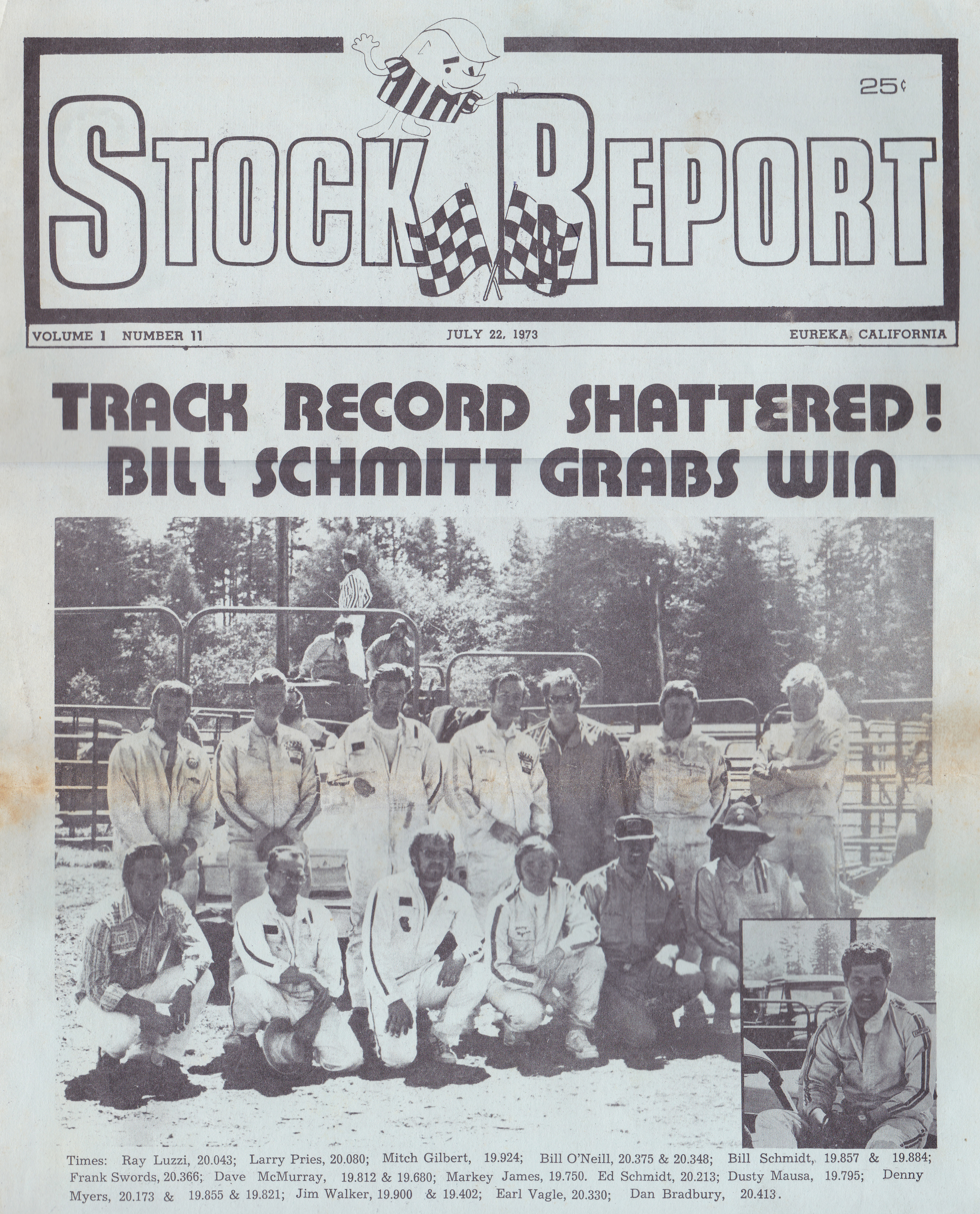
1973 TRACK RECORD BROKEN 20 TIMES IN ONE DAY – BILL WINS A-MAIN

from Dirt Trackin’ At The Acres by Tom Dilling:

“The Biggie for this season, without question, would be the beating that the track record took during timing for the July 8 Open Competition program. The entrants all took a run at the fast, fast Larry Sallady-Lee Tomasini groomed track. Ray Luzzi, Larry Pries, Mitch Gilbert, Bill O’Neill, Bill Schmitt, Frank Swords, Dave McMurray, Markey James, Ed Schmidt, Dusty Mausa, Denny Myers, Jim Walker, Earl Vagle and Dan Bradbury all broke the old record, with Denny Myers doing it three times. But after the dust cleared and all was said and done, Walker ended up with a 19.402. That was on July 8, 1973 and it would stand for over five years. And how many times was it broken altogether on July 8? A nice even 20! All ten cars in the Fourth Heat had broken the track record!! By the way, Bill Schmitt of Redding won the A Main that day…”

Bill Schmitt:

“The tire situation over there; you always took two sets, two types of tires with you, mud tires or slicks. And we started doing the slick thing over there. We were probably the first one to ever do it. The only reason that I stumbled onto it was that I took them over in the car and we got there late. We just didn’t change ’em. We just left them on; man, them things had grab, hold that track and just run, you know. And it was different. Everybody said it was crazy, but it worked. That became the norm. Everybody did that after that.”

“It was kind of funny in those days, we used to take the car we had, with dirt tires because we ran down here quite a bit. So it was all Firestone then that we used. But when it come to asphalt, we never changed nothing in the car. Change the gear and change the tires. And we always got our used M&H, and they had two compounds. And that’s what you bought, those two compounds. One of the two. So you always got the soft ones. But like Redwood Acres over there, you put dirt tires on that track when it was slick and hard like that, about 10 laps, they’d be gone.”

“They even had a groove, you could see it was all dark into the turns, like laid rubber down. Very strange for a dirt track. It was very different, you know. And we drove it like an asphalt track.”
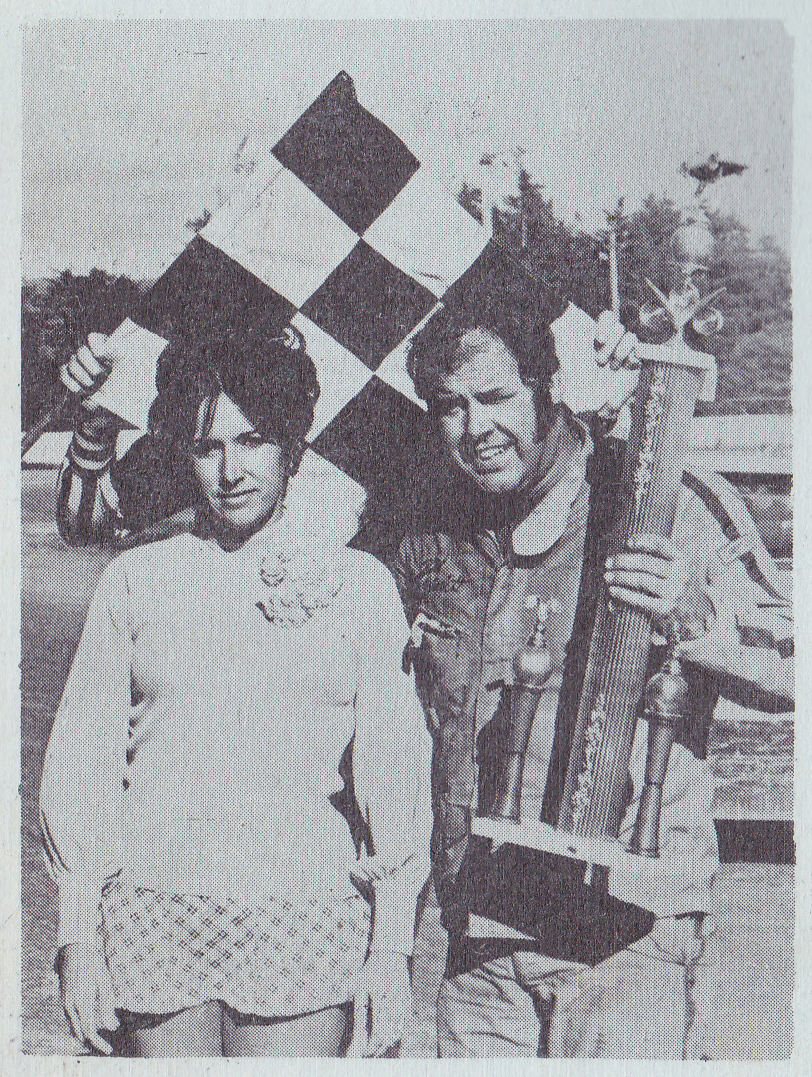
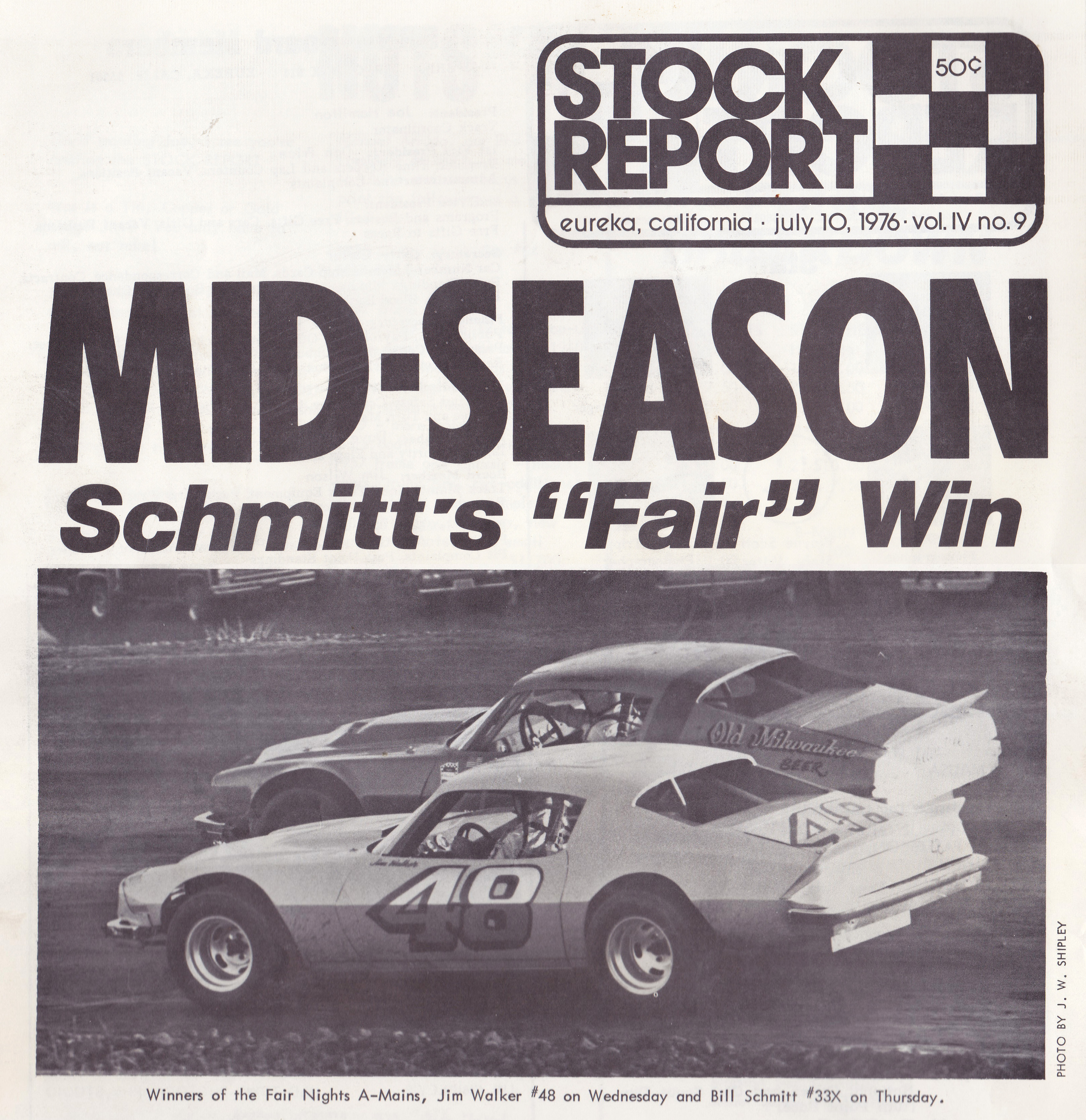
Bill Schmitt wins the A-Main after a record breaking day in 1973

1976 FAIR NIGHTS BILL SCHMITT vs JIM WALKER

In 1976 Bill Schmitt had one of the most memorable moments in Redwood Acres Raceway history, and it wasn’t even a win, and involved the most popular local driver, Jim Walker.

Eureka Times-Standard June 24 1976:

“Jimmy Walker’s A-main win and an outstanding gesture of sportsmanship highlighted the Six Rivers Racing Association program at Redwood Acres Wednesday night. Walker, the Permatex 200 champion who is back on the stock Car racing circuit after being severely injured at Daytona Beach in February, took over the lead on the 33rd lap of the A-Main with Redding’s Bill Schmitt right on his heels. On the 45th lap Schmitt hit Walker’s car going into turn two and the 1974 Camaro spun clear around. Schmitt then slowed down and allowed Walker to catch up and pass him as a capacity crowd roared its approval. Schmitt remained in second place for the balance of the race. “The A-main was one of the best we’ve ever had out here,” reported SRRA track announcer Jim Wilson. “There were lots of out-of-town drivers and several leaders throughout the event. Schmitt performed a real gentlemanly act.” “

from Dirt Trackin’ At The Acres by Tom Dilling:

“During the Fair Night racing there was another display of sportsmanship that will be remembered for a long time. Bill Schmitt bumped Walker on next to the last lap; Jim spun all the way around while Bill waited for Jim and the race resumed. Jim went on to win. Two real gentlemen and sportsmen. Schmitt endeared himself to us all with that display.”

Schmitt would take the second night’s A-Main, beating Mike Chae, Jim Walker, and Dane Smith to the line.

The Times-Standard reported:

“According to track announcer Jim Wilson, a SRRA official, the two-day meet drew close to 5,000 spectators.”

Bill Schmitt, looking back:

“That first night that Jim and I, we had our little bumpin’. Well, we always went over there for Fair Nights, and it was all the drivers somehow promoted the track (the Six Rivers Racing Assoc.) and didn’t kill each other. They had their arguments, but, you know, they had proper meetings and voting and took it very serious. And they got along enough to keep it going really well. I don’t know how they did it, but they did it.”

“So we go over there, but that particular weekend prior to that, we had a two day deal here in Anderson. And I was leading the race down here at Anderson and some guy got into me and I ended up going up in the air and landed on one of the posts that hold the fence right in the grand stand. And it came right up through the floorboard. Right next to me, you know. They had to take two wreckers and pick the car up to get it off of it, So we just kind of tore the car all up that night. We worked hard trying to get it ready for Eureka and we got over there and, and we were late; got in hardly any practice anyway. The race took off, there was a bunch of cars and it ended up with a two night deal – as I recall, you got so many points for positions each night. And whoever had the most won this trophy and $1,000 bucks I think it was, in those days a lot of money.”

“The first night Mike Chase was over there at Eureka that night too. And it was towards the end of the race and Jim Walker and I were way out, gone from the other guys. And I remember it was pretty open area in front of him. And he went into turn and he was doing his normal thing. And the track was getting a little bit slick, so he kinda crossed it up a little bit. So he went up high, so I come down low. But when I come down a low, I went probably in a little harder and I slipped up, just barely tagged him on the back end round he went, Oh man, you can’t do that Jimmy Walker over there. Not in those days; somebody’ll hang ya.”

“So I decided then I just pulled over there on the back straightaway and slowed way down. And again, I was going pretty slow and nobody had caught up with it. So we were right behind the whole pack, but we were leading. Finally he got going and as soon as I seen him get going, I started to pick up a little bit. But I let him get back in front of me. And took off. He won the race that night. And I was right behind him.”

“But the funny part, Chase was almost the one that won to race, ’cause he was getting ready to pass both of us over that whole episode. Anyway, I never thought too much about it. And people all were clapping and going on because he won it. The next morning he picked up paper and here’s a whole big article. And Schmidt was such a good sport, and pulled over and waited for Jimmy Walker.”

“Well I wanted it to be right, you know, especially on his own ground. And, he’d come over to me that next night when they had the second go around. And I think I won it that night, And he was second. So we ended up being in a tie anyway for the points deal. And he come over to me before the race started. He said, ‘Man, this is terrible. I’m the local, I’m the favorite. And you got all the publicity!’ There was a whole page on the thing, never mentioned him once, hardly!” (laughs).

“I ran into a guy here a while back and that was the first thing he started talking about after all these years.”

“Jimmy, he’d come over here to Anderson, him and I got along really well. He was good on this racetrack. He won a lot of races at Anderson. And I felt pretty good that, I could go over there and do the same thing on his racetrack.”
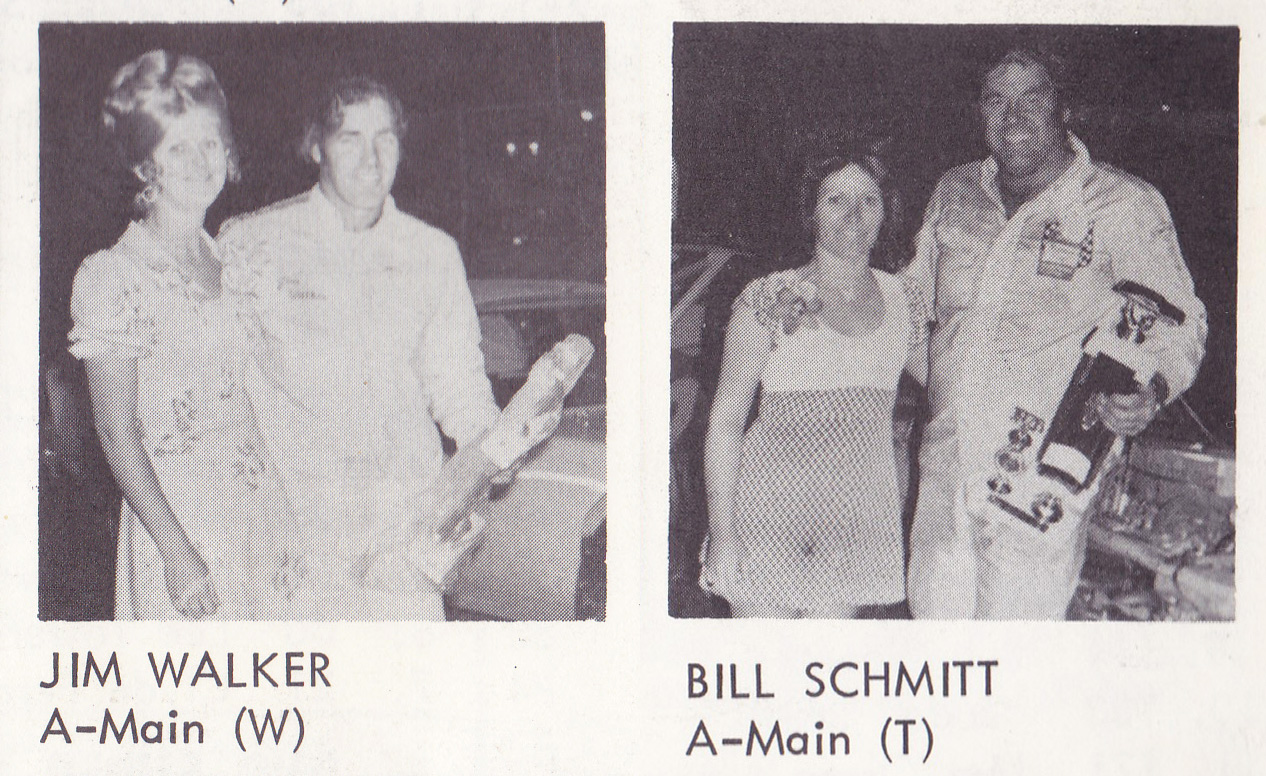
Jim Walker and Bill Schmitt, Fair Nights A-Main winners, July 1976

1978 DIRT CLASSIC AT REDWOOD ACRES

In 1978 the Six Rivers Racing Association, promoters of Redwood Acres Raceway, organized a big Open Tour event with a large purse on the line, drawing many drivers from out of the area including Bill Schmitt and Mike Chase from Redding, Dane Smith and Harold Hardesty from Medford, and Bruce Rhodes and Everett Johnson from Chico.

Eureka Times-Standard, July 24, 1978:

“Redding’s Bill Schmitt, holding off a token challenge from Ferndale’s Jimmy Walker. captured the North Coast Dirt Track Classic and the major cash prize ‘which went with the $10,000 stock car event at Redwood Acres Sunday. Schmitt, starting from the pole position. which he won in Saturday’s qualifying runs. virtually had the 100-lap race all the way, with the Redding ace taking the led only eight laps from the start, and holding first place from then on, snaring the checkered flag and the bundle of cash”

From Dirt Trackin’ At The Acres by Tom Dilling:

“The original purse for Open Competition was a whopping $10,000 but by the time the race rolled around, because of various donations, it was up to almost $12,000. A lot of money, but a lot of effort, too. Just for the record, I had better mention that Bill Schmitt of Redding won that race. Bill is a Winston West Grand National stock car driver and champion. He finished second in the division this past season.”
Bill Schmitt at the 1978 Dirt Classic packing the track [photo courtesy of Doyce Eaton]
Bill Schmitt after winning the 1978 Dirt Classic [photo courtesy of Doyce Eaton]

Bill Schmitt, looking back:

“That was, again, the points deal. Two day race. They put a lot of time into that. They worked all year to create that out of town Open Comp. The stands, they held quite a few people, and they was plum full. They had bleachers on both sides at that time. With the grandstand. So I think in 81, the North Coast Dirt Track Classic, that’s when they had what they called the world’s tallest trophy. And I think Jimmy won it that year. And it was like, you know, a story a half high. And I always wondered, I’m gonna have to ask him, like, what do you do with something like that? Do you break it down or, I mean, it’s just ridiculous. You have to keep it outdoors. (laughs)”

What brought Bill to Redwood Acres to race?

“The people” he says. “And of course the challenge with Jimmy Walker. And that was a big thing. It was like when I started in the West Coast thing and I wanted go beat Herschel McGriff. I got to do that. But it took me a while.” (laughs)

“I got along with them guys pretty good. In fact, when we went up to Medford raced up there a few times, Bert Beck and all those guys were there. They always accepted us pretty well. And it was almost like you had to be part of the clan to be able to get into it. When I got into NASCAR, it was the same way at Daytona. Jimmy had been there, for the Permatex late model race. But, the big guys wouldn’t let hardly anybody in. And the only thing that got me in there was knowing the Allisons and those ties. So once you get in that click, they helped you. But they wanted you to make it.”

“But isn’t it kind of funny that after a guy like Walker and even myself, but you go to these short tracks out of town and you win and you win, those people watch you, but they get tired of watching you. That’s the thing is they want it spread around. They don’t want you to dominate. It’s the same thing nowadays with NASCAR.”

Bill Schmitt with the winner’s trophy of the 1978 Dirt Classic at Redwood Acres
Bill Schmitt takes a soggy rain-shortened A-Main at Redwood Acres in 1979
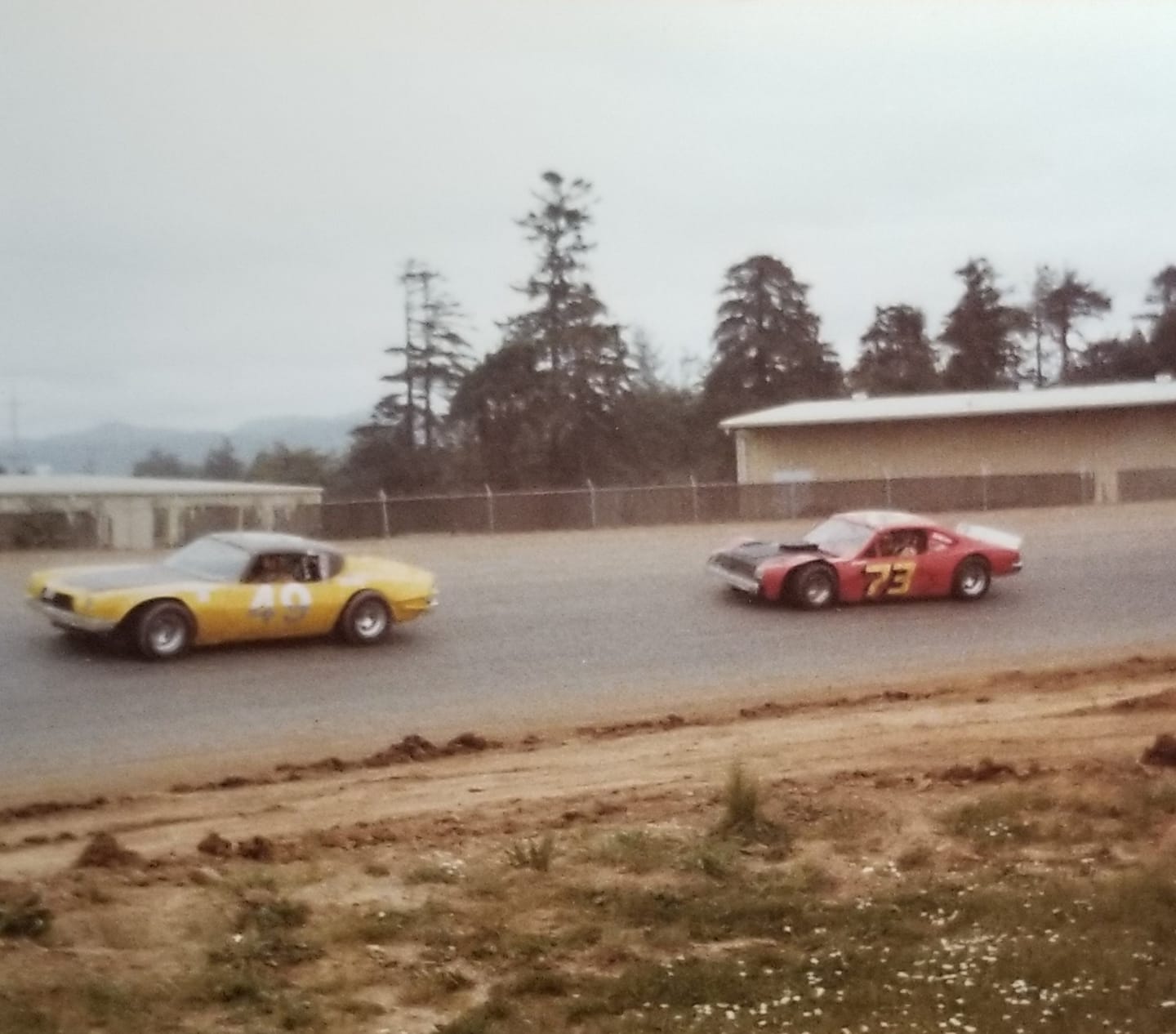
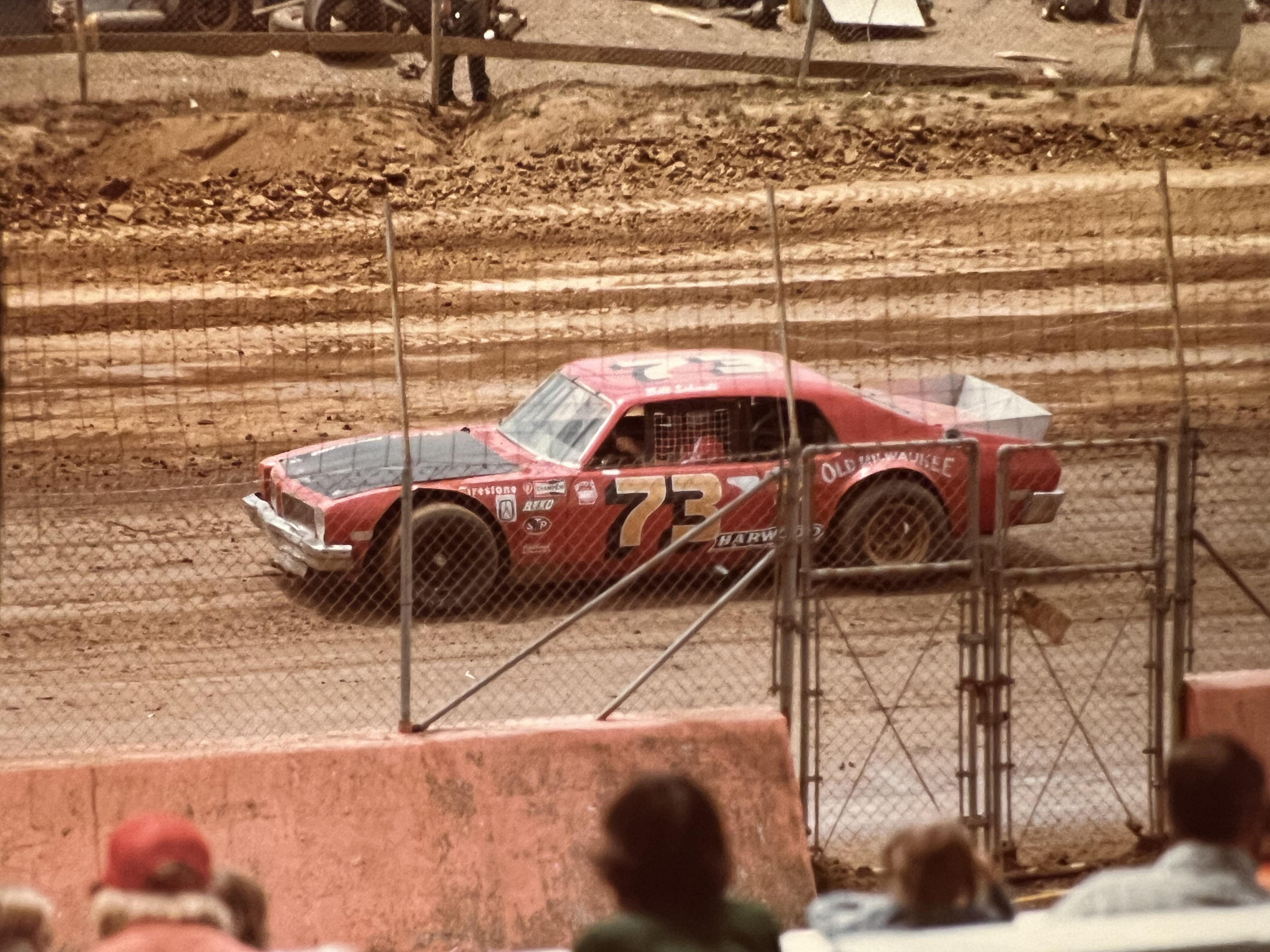
Bill Schmitt #73 following #49 Ken Wallen at Redwood Acres
Bill Schmitt #73 behind Ken Wallen and outside Hank Hilton #98 at Redwood Acres
Bill Schmitt at the 1980 Dirt Classic at Redwood Acres Raceway [photo courtesy of Doyce Eaton]
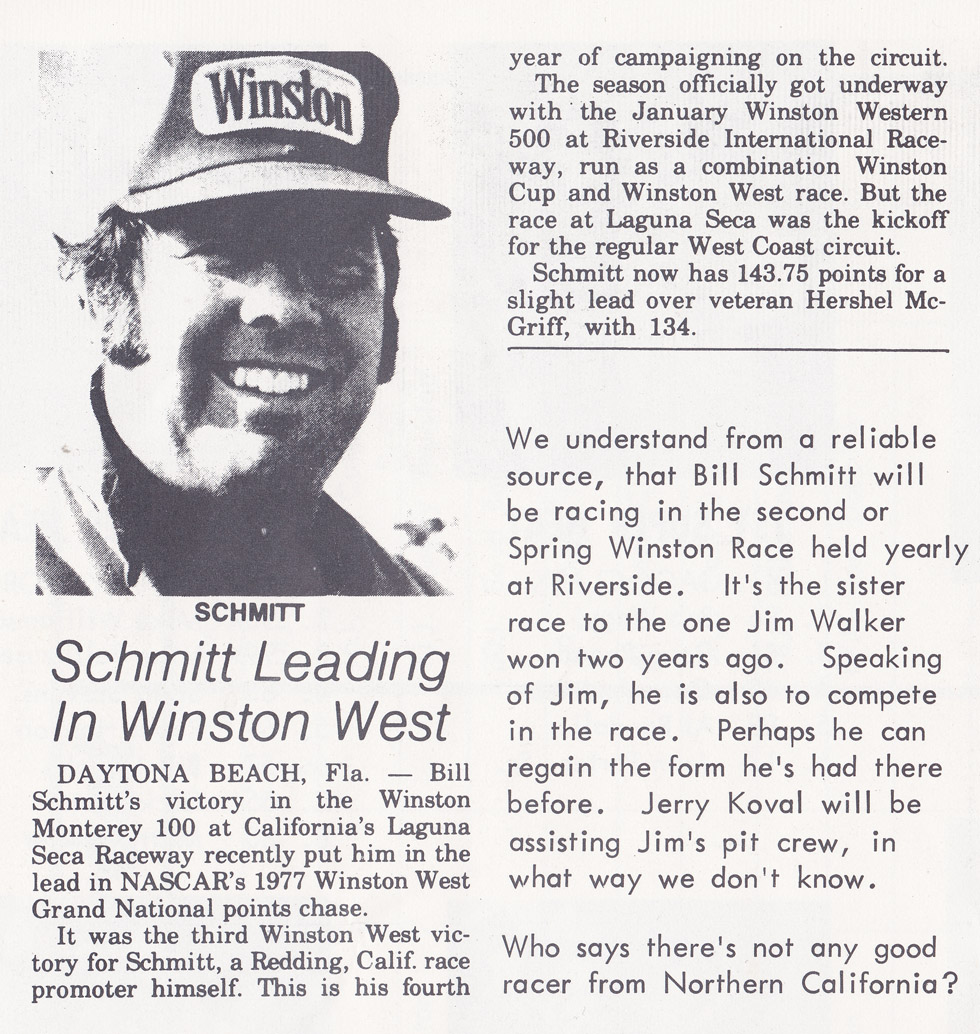
Article in 1977 issue of Redwood Acres race program ‘Stock Report’

A POPULAR VISITING DRIVER AT REDWOOD ACRES

In the old Redwood Acres Raceway program, the Stock Report, you can find photos of Bill Schmitt with his Winston cap on, and it really was a feather in our cap that he was visiting Redwood Acres from time to time, noting how he was doing in the Winston West series and that he was going to be at the Acres that weekend.

“You know, I think actually, what I felt about the way I was taken in over there was I was kind of like one of the regulars over there, you know? And even the press over there would treat me like I belonged there, better than it did here in Redding. Even though they wrote articles here, it was just about the same old thing all the time, you know? But over there in Eureka, they always had a good story with ’em.”

“You know, those fans over there were different too because they were die hard race fans. And I remember those couple of nights over there that people could get. I mean, it was scary. I think if they could do it, they’d jump that fence and come out and kill the guy. They actually were out waiting for him when they come out.!”

SHORT TRACK CARS

In the 80s Bill would come over to run at Redwood Acres other short tracks with a late model that was different than his Winston West cars.

“We had one car then we had built and we used, it was a Nova. And then, then we went to a Camaro,”

“I think the only track that really sticks in my mind, and I’m sure there’s a couple others that I never won and I should have won several times, was Monroe . It was a 5/8 mile. Jimmy had been there too. He used to run his late model up there. And they had $50,000 bucks to win. And they’d always bring in like Junior Johnson’s guy, Bill Elliot was there once he took me out leading the last lap.”

And he took you out?

“He took me out.”

So he took you out, meaning he took you out?

“He took me out.” (laughs)

“And believe me, I’ve never let him forget it. (laughs) He said ‘I didn’t do it intentionally’. I said its pretty bad when he got across the infield to go take me out. (laughs) It’s like, well, you’re too good to done that by mistake. It’s like, you’re too good.”

“In the early 80s Sterling Martin was there one time, and he was leading and I was right behind him, we lapped the whole stinking place. It was a 500 lap believe it or not. We went there and the first time they had it, Herschel McGriff and I were the only ones that stayed in our cars. Took six and a half hours to run it. Him and I were the only ones that didn’t have to have relief drivers. (laughs). Chase and the rest of ’em were all crawling outta the cars.”

There was also a similar race in Calgary, the first NASCAR races outside the United States

“500 laps, and that was the third mile track! I had an 11 lap lead on the 2nd place car. They said you couldn’t pit and get back out without getting down a lot. I did it every time. We were the only ones doing it too.”

JUNIOR JOHNSON, ‘THE LAST AMERICAN HERO’

Born in Ronda North Carolina, Junior Johnson was immortalized in the Tom Wolfe essay “The Last American Hero Is Junior Johnson. Yes!” for Esquire magazine in 1965, and later as a film starring Jeff Bridges in 1973. Johnson went from moonshine runner to winner of 50 NASCAR races, 1960 Daytona 500 winner, and eventually a six time championship car owner.

From illegal stills to illegal race cars, Junior Johnson represented the old stock car adage he has been credited with: “If you ain’t cheating, you ain’t trying.” Still aggressive into his 60s, in a 1991 Battle of the Nascar Legends race on the Charlotte infield, Johnson, unhappy with the officials, was bumping the pace car repeatedly under yellow, which contained Bill France Jr, the CEO of NASCAR, who took the opportunity to get out of the car mid race. When asked afterwards if he had run into the pace car, Junior said in his southern drawl, smiling, “No, they run into me.” When reminded Bill France was in the car, he said “Well he was on the right side and that was the side I was tryin’ to get to”, (laughing).

“Junior liked drivers that drove aggressive. There wouldn’t be a place for him now. Everything was so checked on now. He was an ‘innovator'” , Bill says smiling.

From 1975 to 1993 Bill had been racing in 2 to 4 NASCAR Cup races each year, mostly focusing on the west coast tracks; Riverside, Ontario, Sonoma, and Phoenix, with the exception of Daytona in 1980. He often drove Junior Johnson prepared cars.

“Junior talked slow like a southern Good Ole Boy, but he got things done. I always sent cars over on a hauler for Junior to fix them up and send them back. He told me at one point they were switching over from Chevy to Ford, and I had been running a Chevy. I told him I can’t afford to do all that. This time we sent the cars over and they came back as Fords. When I called him on the phone, he said ‘No problem, all paid for.'” If Junior needed you to drive a Ford, you ended up driving a Ford.

At one point Junior asked Bill to drive for an injured Bobby Labonte at Martinsville in a NASCAR Cup race, but he had to turn him down. “I had a logging business with 200 employees, I didn’t feel I could leave.” Wife Sylvia says “You should have said ‘Yes’!”

Riverside 1977
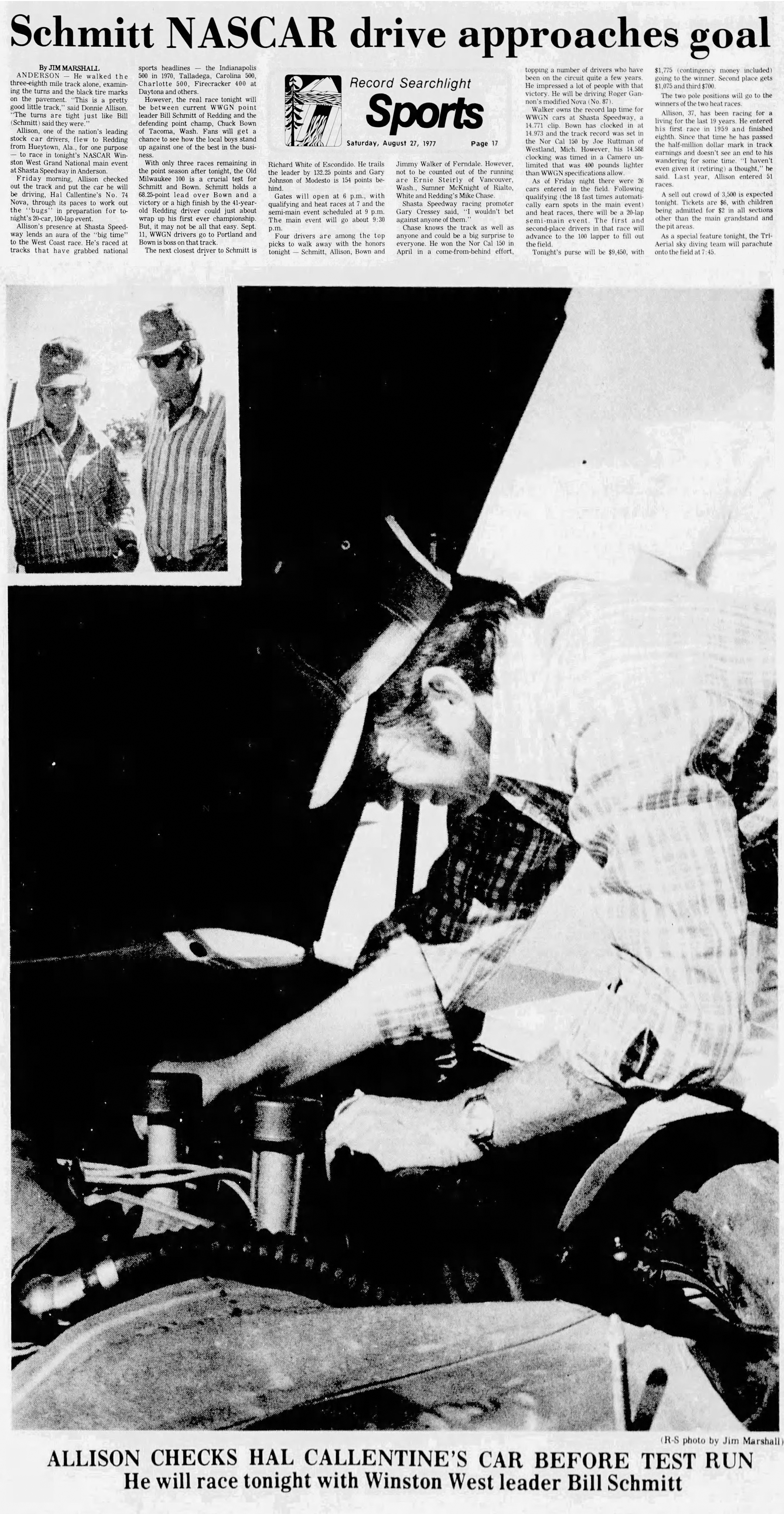
Donnie Allison visits Bill at the Anderson track 1977
Donnie Allison and Bill Schmitt 1978

HANGING WITH THE NASCAR BOYS

Bill knew the Waltrips well. “Michael is a great guy, we kept in touch. You meet a lot of nice people. Earnhardt’s come out and see us, and Allison’s and the Petty’s. They stayed friends, they’re pals, go fishing with them. Allison used to fly me from Riverside and to here in Shasta.”

“Oh, they were a kick. I’d go fishing with Allison. He liked fishing. And then when we were promoting; I’d go promote Bakersfield or a couple other racetracks just for a weekend type thing, special event, and I’d always call him up and see if I’d hire him to come out. I had Neil Bonnett, he was really a neat guy, he’d come out; Donnie Allison, Bobby Allison. They’d come out here to Redding and they’d stay here. In fact, there used to be a bar here on the corner, and they’d go down and play pool. I don’t know what time they came home, but it was the close to the night, you know, and Donnie, he was a nut. That they’d come out, never turned me down, never did. That was pretty neat. Incidentally, my wife, Sylvia, owns all that now, Design Time, that’s our Granite store now.”

“Donnie drove one of my cars at Laguna Seca. and I had something poke a hole in an oil filter on my car, had to pull into the pits, and he went on and he won. Bobby, he drove mine several times. And Dale, when he had that losing streak, he hadn’t won a race for two or three years. He and Teresa had come up and they had a race, he come out and I led, I was way out there for a while. I had about 16 laps to go, he was running second, and I had the stupid engine blow. So he inherited the lead, he went on to win that thing. And from then on he started winning back east. He called me up and said, ‘Man, you broke my jinx, but I’m not coming out there anymore.’ (laughs).”

“Davey Allison, he used to come out here with Bobby and in fact, Davey drove one of my cars at Monroe and, three days later is when he was killed (July 13, 1993 in a helicopter crash in Birmingham ALA). We knew the family pretty well, Bobby and June.”
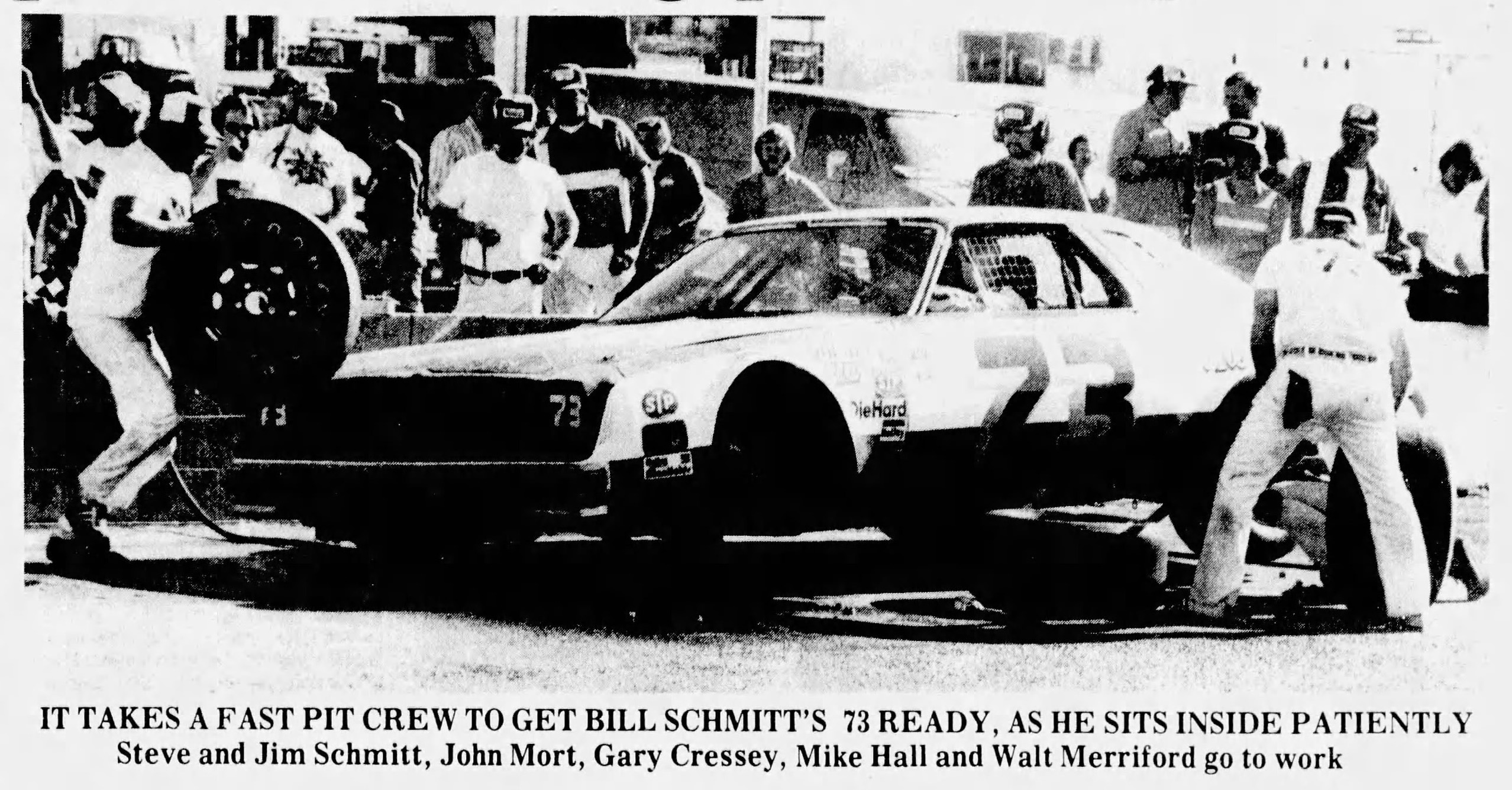
Riverside 1977
Riverside Winston West Series 1978

WINSTON WEST SERIES

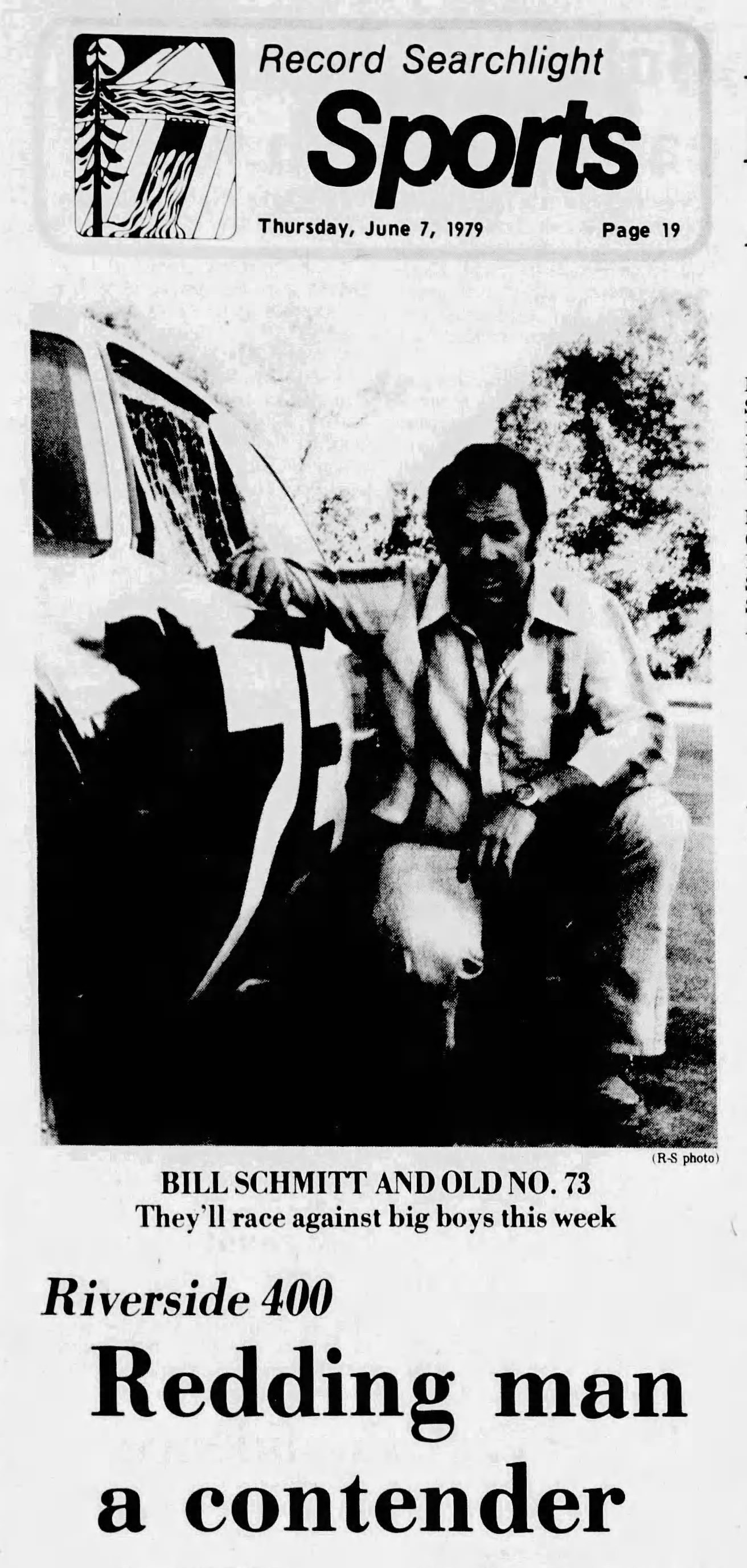
Why number 73?

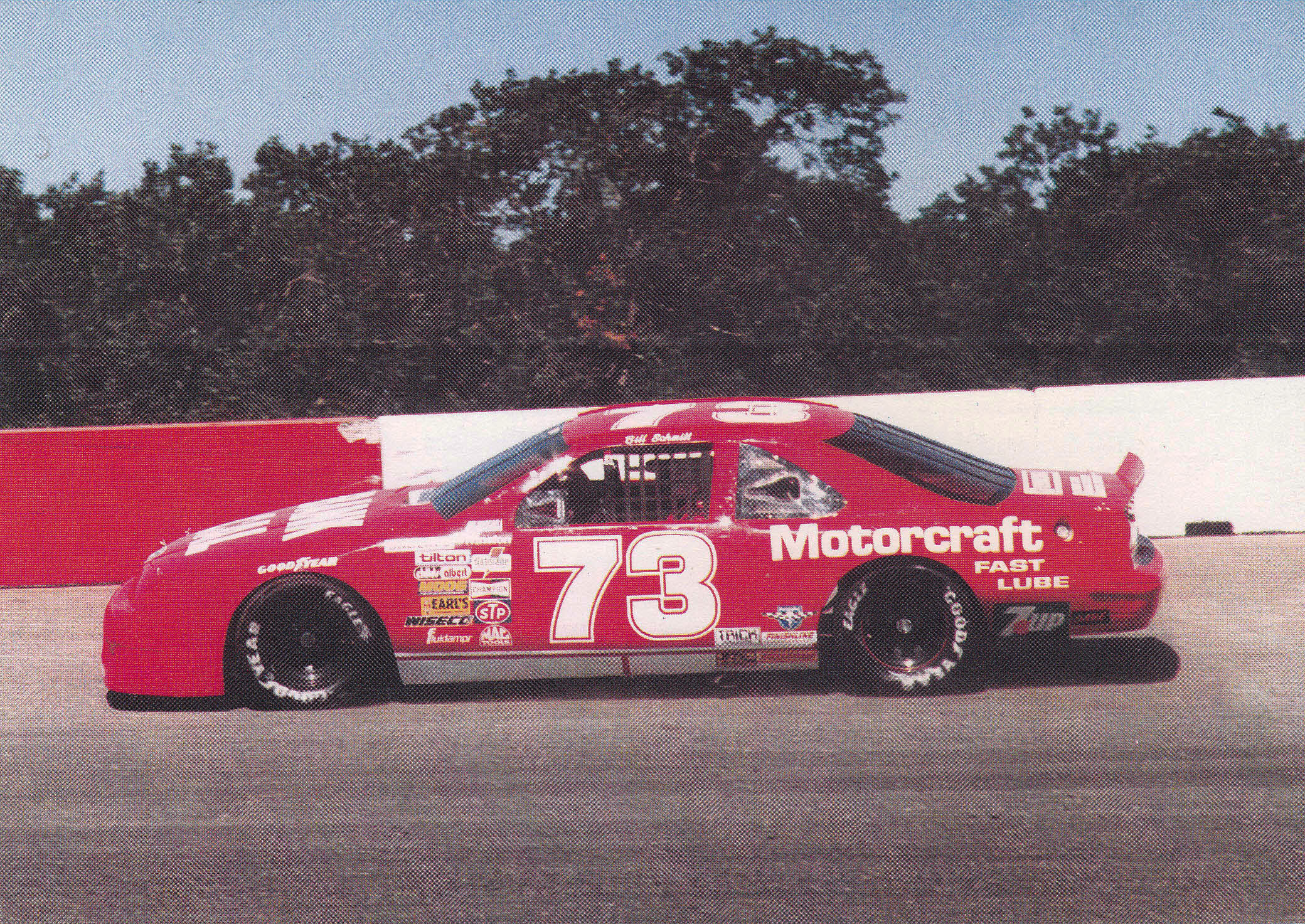
“That’s what NASCAR issued to me. I couldn’t get 33 like I used to run. Wherever you started racing there, that was what they gave you.”

“The first Winston West race I won was Portland in 1975. In Vancouver they had a road course up on the mountain. But it was one of those that if you went off the track, you hit stumps. That would take you out. Had to watch out for the deer across the track. That was in the days of Ray Elder and all them guys. All of ’em were good guys.”

LAGUNA SECA

In 1977 Bill won the Monterey 100 NASCAR Winston West Series race at Laguna Seca in a Chevy Nova. I asked him what the famous Corkscrew was like, going over the crest and dropping several floors.

“I was a logger for years, and that was like driving a logging truck! That was neat, I liked that.” Bill, who logged and owned trucks for 35 years and drove them on the twisty dirt roads could relate. “In fact, I was surprised NASCAR never did the schedule. We had two years we ran there and then that was it.”

ONTARIO OVAL and A.J. FOYT

“When I qualified my best at Ontario, I remember, they had a USAC (Indy Car) show there, and they had stock cars as well. Ontario was supposedly just like Indy and they had those markers on the turn (…3…2…1). And I can remember distinctly, everybody said, you gotta get past ‘2’ before lifting to make it, you know, if you are going to get a fast time. And it was hard to do because you’d start seeing the numbers pretty soon you find yourself looking too much at them numbers, not paying attention to what you’re doing. And I can remember going past the ‘1’ marker before I lifted. And I thought, ‘this isn’t gonna work too good’. But it stuck and got around, you know? And old A.J. Foyt, was doing double duty, he had a little Camaro he ran, he was on the pole and I was on the outside of the pole. And I think I was about 151 mph, A.J. was just a fraction faster. And Sylvia was sitting by the pits there, and A.J.’s wife was next to her, they didn’t know each other. I guess A.J. come over and sit down and says to his wife, ‘Who is that guy!!?’ You know, never heard of me before. (laughs).”

“I was running my Grand National, and A.J. was running his Camaro, and the open wheel Indy car the next week. But I remember we had to park outside because we didn’t have enough clout around there to be in the garage. They didn’t have enough garages. And it rained all week and they postponed it. Of course we covered the car up. They didn’t allow no practice or nothing. They put the car down the line, took off and that thing just hissed and popped. So I lost about two laps trying to get that straightened out.”

ROAD COURSES AT RIVERSIDE and SEARS POINT

Bill won at Sears Point four times. “I like road courses. The best finish I had with the cup cars was when they came to Riverside. I finished third there once. Good track. It was one of those that psyche you out a little bit. If you like the dog leg, you could run through it wide open, but if you were first timer on there, man, you’d back right off.”

In 1980 the Eureka Times-Standard reported while local driver Jimmy Walker would forego the Stock Car Products 300 at Riverside International Raceway to put together a new Camaro race car, Bill Schmitt expressed high confidence heading into the race:

“Bill Schmitt of Redding will drive in the Winston Western 500 Sunday. And the new NASCAR Winston West champion has the other drivers worried. He is loaded with self-confidence and has convinced himself he is going to win. “1 think we’ll blow their doors off,” he predicted. “We had a good year. We won four races, led twice as many laps as anybody else, and at Phoenix last race of the year, when he clinched the title, Neil Bonnett won in our backup car.” Schmitt’s doggedness in pursuit of victory was never better illustrated than in the Napa Arizona 250 Starting his Oldsmobile on the front row next to Richard Petty, he needed to protect a 12-point lead over NASCAR Winston West rookie of the year Tim Williamson of Seaside. “On the second lap Jimmy lnsolo blew his engine and dumped his oil right in front of me,” Schmitt said. “I spun and hit the wall and lost three or four laps. I thought I was done for right then and there.” But the lumberman from redwood country took off in pursuit of the field, working his way up to 11th place at the end of the race. Young Williamson, who finished a strong fourth one lap behind Bonnett, Bobby Allison and Petty, picked up seven points on Schmitt, but that wasn’t enough. So now Schmitt looks at racing the kings of the super speedways differently. “Jimmy lnsolo and I have got our heads together. He says he plans to win the pole position, and I say he may have to move over to make room for me on the front row,” Schmitt said. “We don’t care where those other guys start. We were always behind the eight-ball out here on the West Coast, because we didn’t have enough of this kind of racing. Now, with Ontario and Phoenix so close together, we think we’ve got our act together. Before, I was always so darn nervous at Riverside Now I’ve got more knowledge and a better engine. They’re gonna have a tough time with Bill Schmitt.”
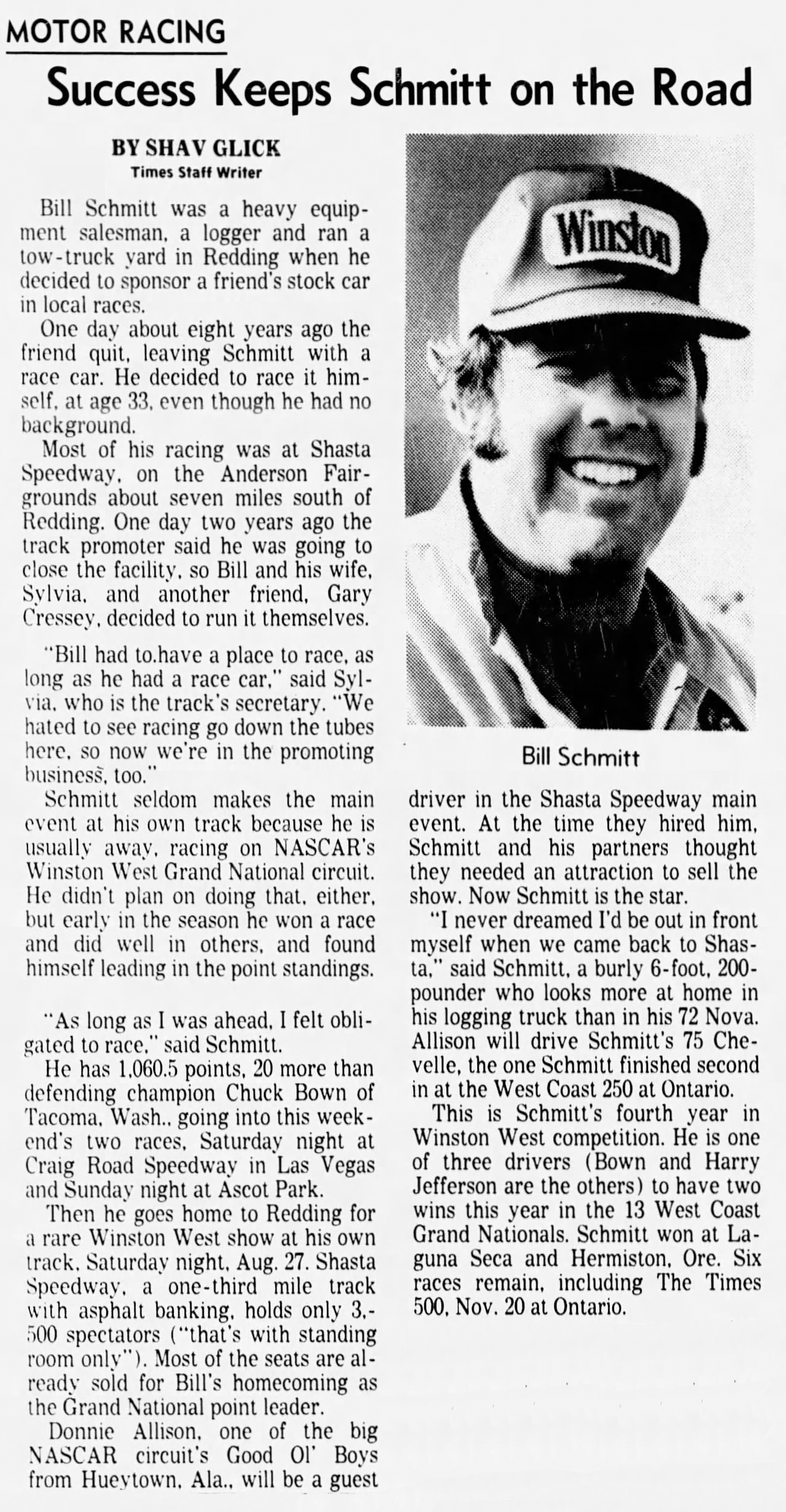
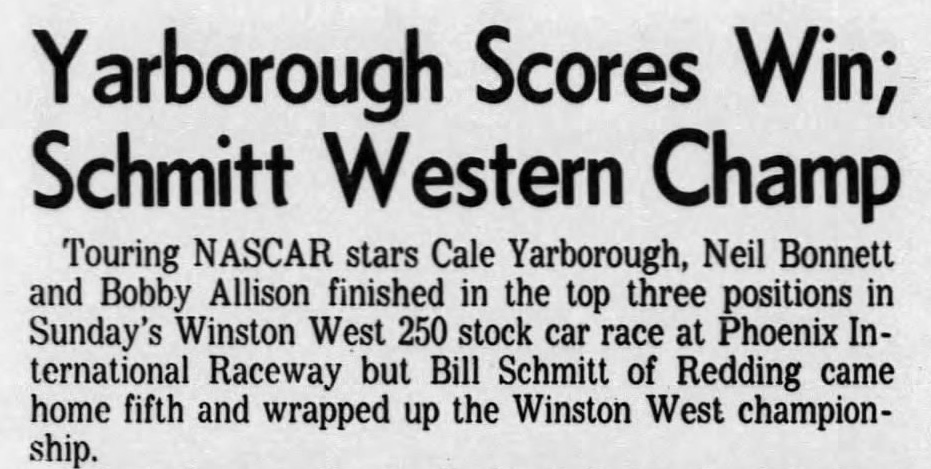
Bill leading Winston West points, Los Angeles Times Aug 1977
Bill clinches Winston West Championship, Lost Angeles Times Nov 28 1977
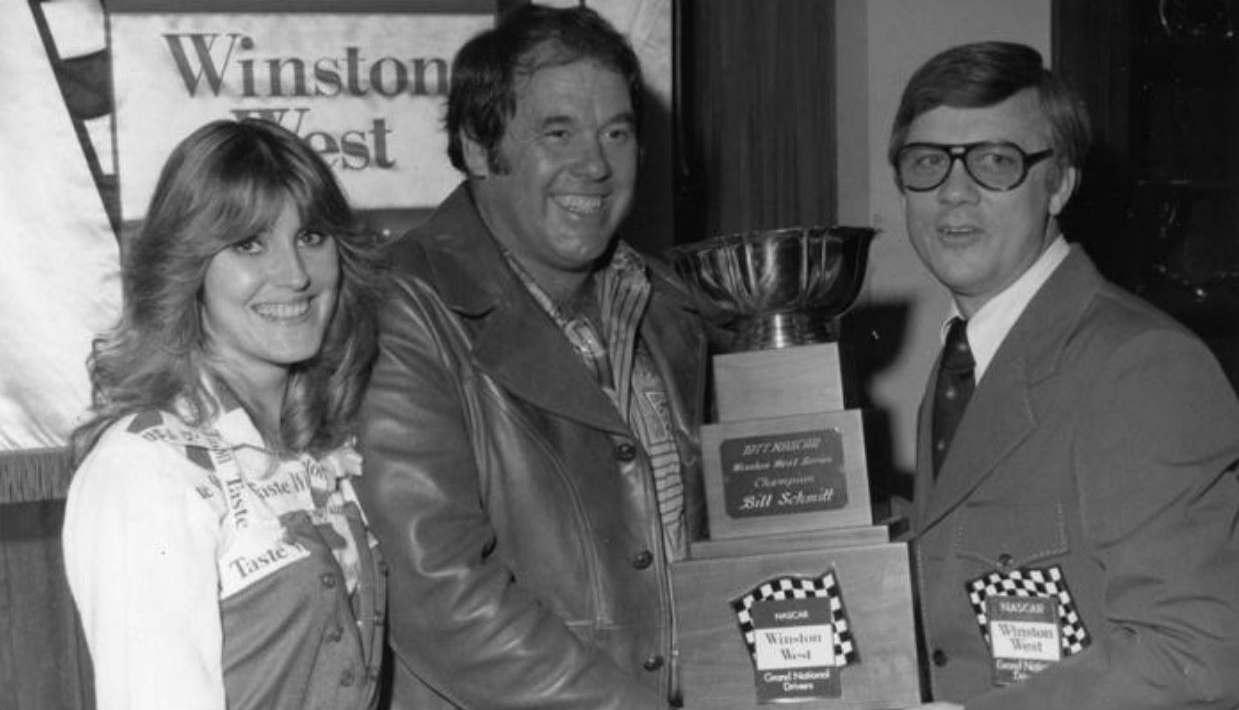
Winston West Champion 1977

WINSTON WEST CHAMPIONSHIPS

In the November 8, 1981 Eureka Times Standard, Don Terbush wrote:

“Perseverance is a quality that has stood Redding racing driver Bill Schmitt in good stead throughout his career. Schmitt, a familiar figure to Six Rivers Racing Association aficionados because of his many appearances at Redwood Acres, thought for awhile that his racing luck had deserted him. One of NASCAR Winston West’s foremost drivers — series champion in 1977 and ’79 — and winner of 10 career Winston West events, Schmitt hit a dry spell. Or perhaps it should be referred to as a drought.(…) But Schmitt never quit trying — not even when he was tempted to stay away from the Sears Point race. “I entered, then withdrew, because I didn’t think I could leave my businesses in Redding,” he recalled “But then things straightened out at work and I re-entered. We didn’t even start working on the car until the Tuesday before the race.” Schmitt’s decision to compete in Sonoma proved not only wise, but profitable. He added $5,525 — his largest career payoff to his racing bank account with the triumph and ended many months of frustration. Buoyed by the victory, Schmitt will now turn his sights toward a return visit to Riverside International Raceway on Nov. 22 for the Winston Western 500 The Win-ston West drivers will be competing with their Winston Cup “cousins” in this event Schmitt finished third at Riverside in August in the Warner Hodgdon 200 race.”

Bill Recalls:

“First year I run full time, I won the championship in ’77. And I won ’79. It was kind of funny ’cause I couldn’t do nothing for two or three years there. Just couldn’t get it together. But my oldest son was crew chief and he built the cars. And he understood what I needed. He wouldn’t drive ’cause he had to wear glasses, he couldn’t see. But boy, he could build a good car and set it up. And he didn’t even ask me what I needed. He just knew what the car needed. But when he was off in the eighties, he had some other stuff he was doing, but every year he’d come back, I’d win a championship. So we won in ’89 and ’90, across three decades.”

“We did everything here, in fact, built our engines here for a long time. Terry Elledge, started out with us. Terry went back east. He’s still going. He, he’s on the road to retire. Of course his boy Jimmy Elledge, he was a crew chief for Dale Earnhart for a while. A million bucks a year. So he must be pretty good at it.”

“Then after that was Lloyd McCleary, they called it Pro Power then, they built the engines. He’s back east. Everybody’s who’s worked for went back east. So if nothing else, it set them guys up pretty good shape. My problem was, I was just too late in life starting and I should have been doing it this these days, you know? Right. Now the bucks are in there. And it’s kind of strange to hear what they do to set the cars up ’cause it’s just the opposite of what we were doing. Like that Bump sitting on in rubbers. Shocks were a big thing, our days was a pair of Monroe 50/50s and that was it.”

“Mike Chase, he recently stopped by here, He works for Penske now and he’s the total shock man. He’s been doing it for the last 12 years, and he’s their shock expert. He said, you’ve never seen so many shocks, different combinations, in your life. And he says that you gotta dial it in; boy once you got it dialed in, you got it. That makes a car.”

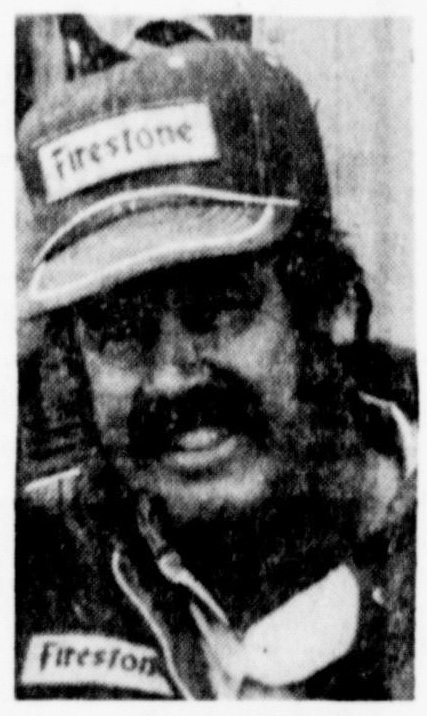
1980 Mesa Marin
1980 Daytona

DAYTONA

“You go out there and shoot, I get up on them banks and next thing I knew I was down on the flat part, you know. I felt pretty comfortable down there”, Bill says laughing. “And I’d come in and Sylvia always kept track of everything. And she’d say, ‘Well, you better get on it’. And I said, ‘Well, geez, I must have been flying.’ She said ‘Well, everybody else are doing 185 and you’re doing 150.’ ” (laughs)

“So Neil come over and he jumped in the car and he says ‘lemme take that car out. You think there’s something wrong with it or something?’ First lap is 186 miles per hour. He was faster than anybody with that car. And he says, ‘All you gotta do is keep your foot on the, if it tries the lift, take the other one and put it on top of it. Don’t touch the brake and don’t turn the steering wheel’ (laughs). He was right. You could go through there flatfooted and it’d be so much g-force, it’d sucked the engine down about 500 rpm.”

“That draft’s a different thing. You gotta get used to that. You’d feel like, man, this guy’s really slowin down, you’re half throttle behind him. So you’d think I’ll pass him, heck with it; you pull out, get up alongside the door, that’s far as you go.”

Bill getting into his VW street car after Winston West practice in Phoenix November 1981
[photo courtesy of David Allio http://www.racingphotoarchives.com]
Bill returns to Shasta Speedway 1982
Phoenix win 1984
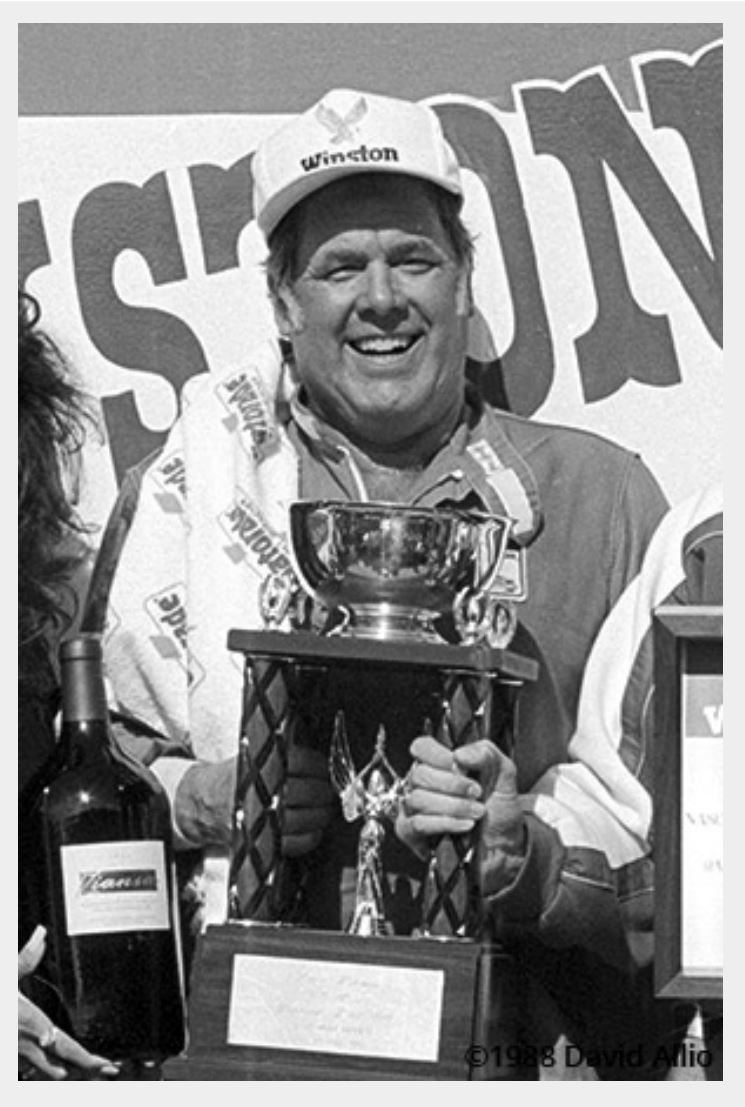
Victory Lane at Sears Point 1988 [photo courtesy of David Allio http://www.racingphotoarchives.com]
Official program for NASCAR at Calder Park Thunderdome, Mebourne Australia February 1988

OVER 200 MPH DOWN UNDER

On February 28 1988 Bill also raced in Melbourne, Australia, at the Goodyear 500. the first NASCAR race outside of North America. The race was at a newly constructed track, the Calder Park Thunderdome. The field included Bobby Allison, Neil Bonnett, Dave Marcis, Kyle Petty, Michael Waltrip and Hershel McGriff. Bill qualified 16th of 31 drivers but finished with a DNF on lap 31 due to engine problems.

“The promoter sailed a container ship in, loaded the car up and hauled our junk and made our way over there. We stayed an extra couple weeks, but we were over there almost a month. It was the first race they had. It was a mile and a half track and it was probably between a Darlington and a Bristol type track, and it was fast.”

At Calder Park drivers got up over 200 miles an hour. At Texas World Speedway 214 MPH. What were those speeds like?

“Now you go 230 down the back straightaway in Daytona, it seemed like you’re going 70. Till you’ve pulled up on someone!”

Bill returns to Victory Lane at Sears Point April 1988
1991 postcard
1991 article
1997 Grandstand trading card
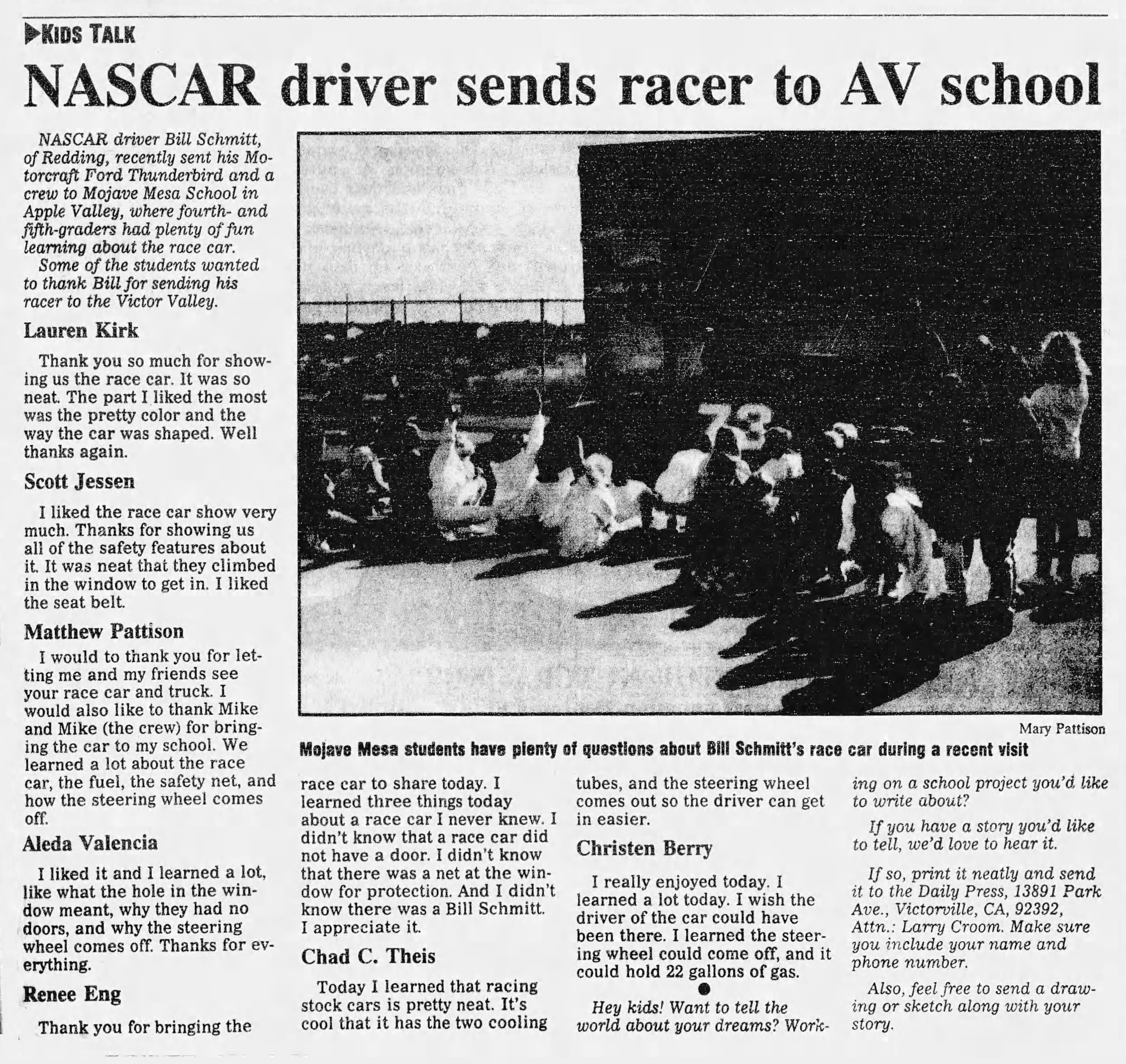
Bill often visited schools like this one at Deer Creek Elementary School in Shasta in 1978
Thank You messages from 4th and 5th graders at Mojave Mesa School,. Apple Valley CA 1991

LEAVING RACING

“I quit in 1994. Butch Schaeffer, he runs the West Coast Series now, they’re trying to put a race on down here at Shasta next year. And they said that the promoter wanted to get with me and wants me to drive. And I said, ‘You want me to drive? I mean, I don’t even go to a race anymore.'” (laughs) I said, I quit because it made me want to go race and I don’t wanna do this no more. I said, I’m too old to go do it. He said, ‘Yeah, but Herschel McGriff is still doing it.’ I said, well that’s Herschel. Look at it. The first 10 laps he was down 2. I said, I don’t wanna go out there and look like an idiot. I said, furthermore, I doubt when I could even get in the car because the way they got it built today. You know, like Gordon and those guys, you see pictures of ’em, but you never realize how little they are. About like a jockey.”

“My granddaughter got pretty well involved in it. My son was building her cars and she got pretty good at it. And she’d called me up, want we come down and help her out a little bit. So I’d go down there once in a while, finally one day said, you get in the car and see what you think of it. And I went out and broke track record first two laps out there,”

Bill said he won quite a few races and trophies over the years, usually giving them away to family and grand kids.

“The worst trophy I think I ever had is I won this Pepsi thing down here two or three times. And it was an eight and a half foot trophy. Wouldn’t fit in the car, I’d give it to Napa, they’d put it in their showroom.”

“I got involved with these kids and the Pinewood Derby Races and stuff like that. So they wanted me to come in and flag for them. So I’d go to those deals, and all they’d give ’em for winning was a ribbon. It was about once a month and I thought, you know, that’s not really good. So I started taking my trophies and I’d take the name off of it and I take them to give away to the kids. Then I got Goodyear to throw in sponsor coats and hats. And boy, I mean, them kids really loved that. (laughs) Pretty soon the dads were wanting coats, like sure, you know, bring some big enough to fit them.”

Bill Schmitt surrounded by trophies at his office, October 2013

Kind thanks to Bill and Sylvia Schmitt for their generosity in opening up their collection of photos and stories of Bill’s racing career.

Thanks also to Doyce Eaton, Mark Baldwin, Mike Marcelli, and other fans for their contribution of rare photos.

ED TANFERANI

CLOSING THE DOORS

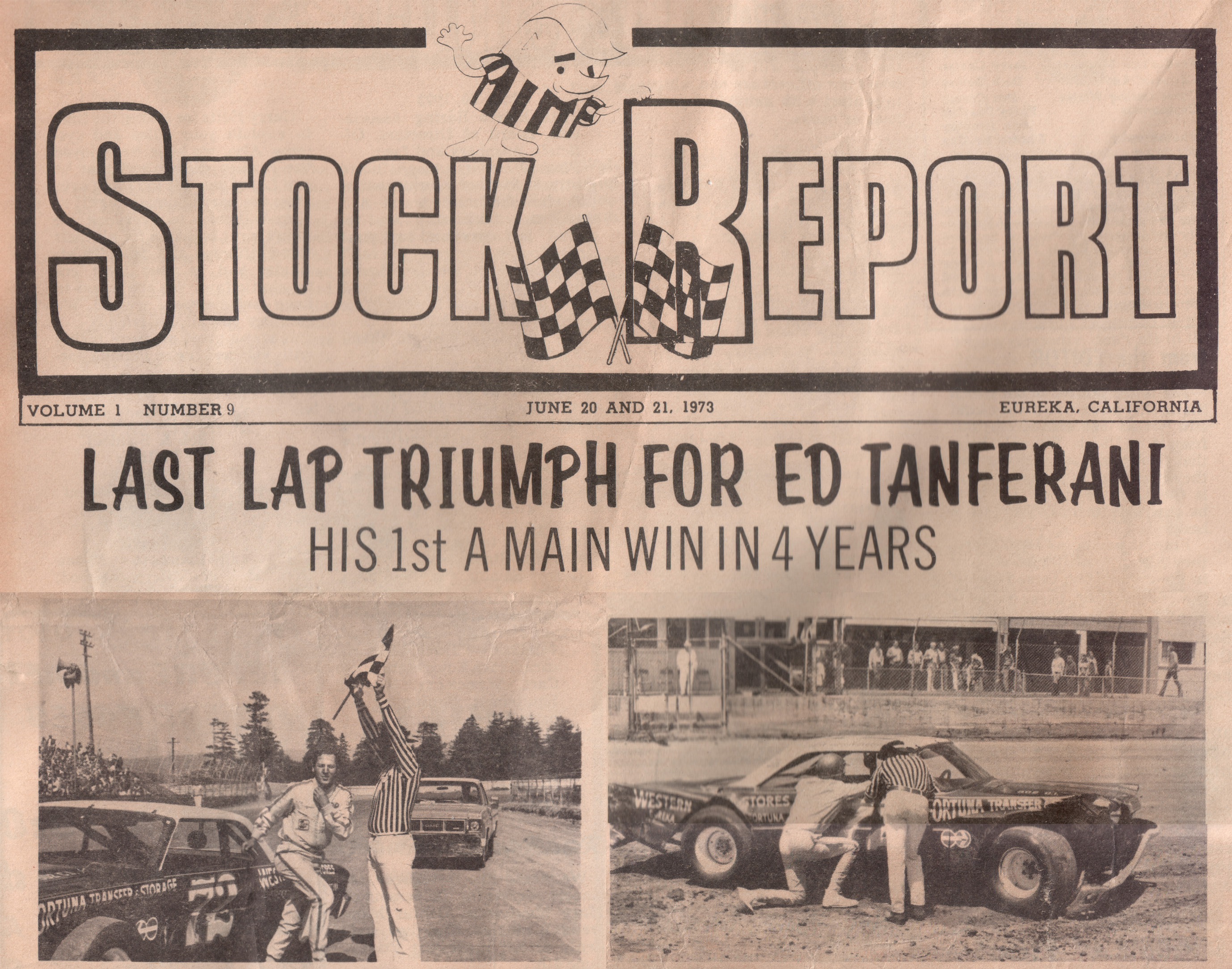
After over 50 years Fortuna Motors was closing its doors. “Lost the Chevy franchise due to the bankruptcy they declared, over 3,000 of them going away”, Ed Tanferani said in a visit to the recently emptied dealership in 2014. A young looking 71, Ed was retiring his car business and looked ready to get back out on the track, appearing no older than 61. “So far so good, huh? That’s right!” he replies with a laugh.
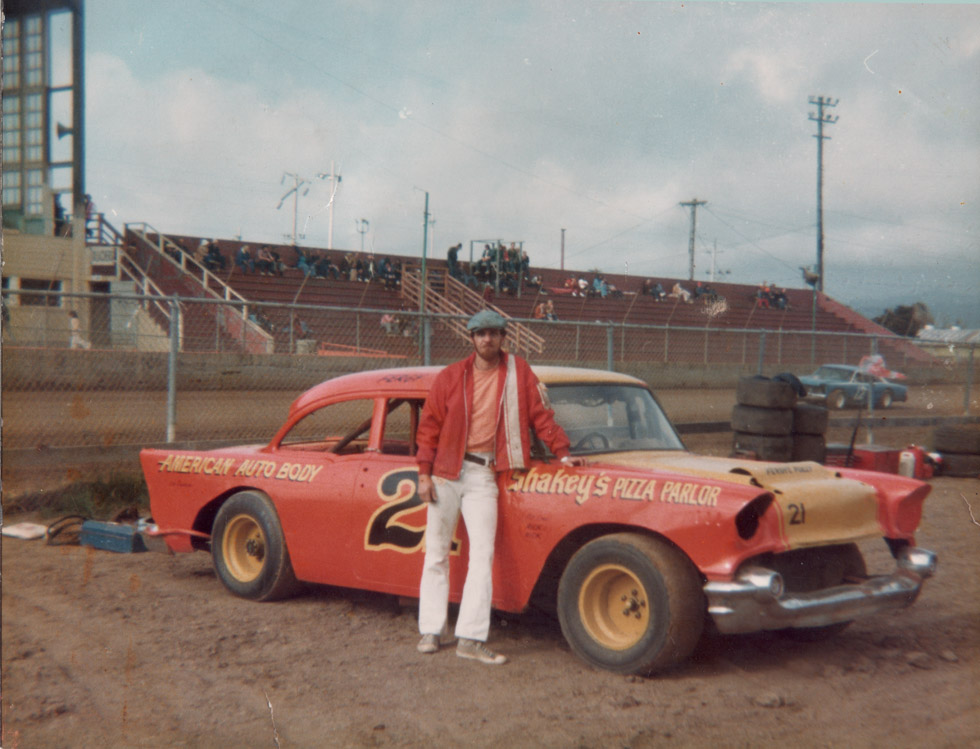
The ‘Rhonerville Rocket’ couldn’t get racing completely out of his blood. “My wife says every time we drive to Santa Rosa, ‘You’re not on the race track, just calm down!’ You just get in the habit of wanting to get around people. The police officers just don’t understand that though.”

Ed opened up his photo collection and clippings while answering questions about his racing at Redwood Acres Raceway in Eureka CA and his many trips to southern California to race at the legendary now extinct tracks like the road course at Riverside and the speedway at Ontario.

FIRST DRIVING EXPERIENCE AT REDWOOD ACRES:

A Traveling Carnival of Crashes

“I was born in Eureka, where they had a hospital, raised in Loleta, where my folks had a diary ranch.” His father owned a Ford dealership, and the old racing saying of Win On Sunday, Sell On Monday, was taken literally in the Tanferani family.

“In 1962 at Redwood Acres they were motorcycle racing a lot, 4 or 6 times a year, flat trackin’, and a lot of guys were into that. I think two times in ’62 some stock car guys came down from Portland and they’d get the word out in the local papers – ‘There’s going to be Jalopy races at Redwood Acres, winner takes all, all you need is a rollbar and a seatbelt, and all the glass removed’,” A reminder that you didn’t need seatbelts in regular cars back then, but they were going to be real safe for the races and have them. “So I get a ’53 Ford sedan we had on the lot, and it was a junker, six-cylinder I think we had in it, and I got a bunch of water pipe my grandmother had underneath her house in Eureka and I made a rollbar out of it, and they sent you something in the mail what it was supposed to look like. Nothing on the door, just front and behind the seat and front to back on both sides, and that was it, I guess keep the roof up. And these were shysters, they were barnstorming guys, and they’d come down here and they’d tow a trailer and bring a jalopy and they’d bring four cars. And the way it went, we all felt it was a race, but it was a show for the crowd and you’d be racing dodging through cars and I was in 3rd place trying to work my way through anybody and everybody, and here would be some guy going slow down the track and he’d pull out and hit you, and the crowd would cheer and that was the show. It was 50 laps or so and the second race I was really pissed off and I was going to dodge those guys still not knowing what they were doing, and when it was over I wrecked bad and we were all waiting around for the money, they all disappeared. They didn’t pay anybody.” Like a carny, they were gone, disappearing off into the night.

“Then I left for a year and a half and finished college, then I came back to Redwood Acres around ’66 and that’s when I started getting into races.”

On driving on the dirt, Ed said – “Like Harold Hardesty said, you could drive differently depending on what the dirt was, so you’d make the car adjust to the track, but on asphalt its the same every lap so you almost have to have a perfect car. Its an adrenaline rush, you get hooked on it. You just needed it. Once you hit it you hit it.”

SIX RIVERS RACING ASSOCIATION

For the 1965 season, the drivers at Redwood Acres formed the Six Rivers Racing Association (SRRA).

With the SRRA established, you had racers running the show, no single promoter. At that time Chevrolet was so prominent on the track that there were car classes based on which year of Chevy you were racing. “Part of the problem was I was running a Ford and it ran pretty good occasionally, and back then everybody ran Chevy’s, and if you beat a Chevy, people would get up in arms. People in the stands and everything. Nowadays they have to be all identical wheelbase. But what was neat about back then a guy could be low budget. Any guy could bring a race car out there one way or another, by hook or by crook. We’d go get parts out of the wrecking yard and from cars that had been thrown in the water at the turn in the river; get A-arms and sway bars that we needed, cut them off with torches and use them.”

Ed was on the SRRA board initially. “Oh, it was educational. You understood, from the organization side of it, but really what happens, you’re more trying to enforce the rules than you are worried about the crowd. The races would take all day sometimes. Because they’d be having these meetings during the race. When you have a promoter, really all he cares about is the crowd. He wants to keep the drivers happy. ’cause he needs the drivers to show up and he has to put the promotion on.”

Bob Britt’s 101 Speedway between Eureka and Arcata 1968

BOB BRITT’S RACE TRACKS

Bob Britt (of Britt Lumber) came to Redwood Acres to race in 1964 in a ’46 Ford that he would add a Chevy engine to, and became an early SRRA Track Champion at Redwood Acres. He then built the 101 Speedway on the hill over the lumber yard next to the Hwy 101 corridor between Eureka and Arcata, where the SRRA held races. “He had two tracks (the first was below next to the highway on Humboldt Bay in the lumber yard) and the north wind was always blowin’ the dust right into the stands, so he went up behind it on a flat and built another track.” SRRA races at 101 lasted for one season before moving back to Redwood Acres for 1969.

“The best thing is Bob had a lumber yard right next to Redwood Acres on Hubbard lane where they worked on the car and they wouldn’t even trailer them to the race, they’d just drive it across the road to the race. We were jealous, towing our car from Fortuna”, he says with a laugh. “We’d have a truck and they’d tow me from Fortuna all the way to Redwood Acres with a chain and I’d be sitting in the car with my goggles on hoping I didn’t get caught.”

Back at Redwood Acres for 1969, Bob Britt won 7 of 14 main events, with Ed winning 3.

“Bob had his own car for a few years but then he was driving for someone else, figured out not to always spend your own money. Bob was a real good driver; methodical and, uh, calm.”

Ed Tanferani at Medford 1968

NASCAR RACE AT REDWOOD ACRES WITH HAROLD HARDESTY SEPT. 1968

On the mystery of the 1968 NASCAR race at a rainy Redwood Acres won by Harold Hardesty of Ashland with a victory photo of Harold with trophy sitting in front of his car on a trailer, Ed clarified – “His car broke”. I asked Ed if Harold’s account in my previous article was about right, he said “You’re damn right!”

The race had a small car count. “They knew they were going to be short, so they called around and anybody who wanted to bring their cars in they were going to have a separate race and put on a duel show, give the crowd their money’s worth. And then two or three of the cars broke, and another guy wouldn’t run because the track was so muddy.”

“Harold wasn’t going to race, so they wanted us to race. And then Rudy Zeck and I, Rudy was there with me, he used to race but he didn’t bring a car out that night, and we thought shit, we might as well let Harold drive my car, he’s a NASCAR guy, we’d raced and had fun and we were over, and while it would have been fun to race with them, I didn’t feel comfortable, that’s what I told Rudy. And Rudy said ‘Why don’t we see if Harold wants to drive your car?’, and he said ‘Yeah!’ He didn’t think about it”.

Harold said he loved jumping into strange cars, said it was a special talent he possessed. “There you go” says Ed. “He loved Redwood Acres. The Medford track was a quarter mile but it was banked quite a bit so it was a bowl. We raced up there quite a bit. Harold loved Redwood Acres for the speed. And I’ll tell you, when the track was a certain time he’d get out there and put on a show during hot laps. He’d come down and throw his car sideways at the flag stand and keep it all the way around and shoot down the back straightaway, very impressive. He had a talent and he learned it on that short track, because once you figured out Medford you had to be crossed up most of the time up there.”

The track was transformed into a quagmire from the rains – “Real bad, they had to blade it down and roll it to berm it up high and low and they just ran in the middle of it. We ran in the middle of it in our races, then they needed cars to start the race with, told the locals to start in the back and pull in, but we never pulled in. Nobody pulled in, everybody was just racin’ – you know how racers are! And then it started spotty rainin’ and I think NASCAR just wanted to get the race over with, so they let it go.”

On Harold Hardesty, Ed says “He was a fine gentleman.”

Harold Hardesty (in gold) with 1968 trophy
Redwood Acres Raceway October 1969
Ed Tanferani in his ’58 Ford 1969

FIRST 100 LAP RACE AT REDWOOD ACRES

“At the meeting of the SRRA they said we want to do 100 laps and everyone said we can’t even get through 30 laps – we better start a lot of cars! Walker was leading it, I was in 2nd, and I think he broke with a couple of laps left, and I won. In fact I found my hub was broke after I got home, so I would have only made it a couple more laps.”

It was detailed in the 1969 Eureka Times Standard story and Dirt Trackin’ At The Acres that due to a scoring mistake, the race actually went 102 laps and Jim Walker should have been awarded the victory. Yet true to his “Gentleman” nickname, Walker upon learning of the mistake called the SRRA and told them not to worry about it.

TEAR DOWNS AND TIME OUTS

In Tom Dilling’s book, Dirt Trackin’ At The Acres, he indicated that Bob Britt grew tired of having his car torn down for winning often, and left racing.

“Bob Britt was about 10 years older than us, or a little more. He raced a little bit when he was young, in the jalopies or the hard tops, so he had a little experience. They ended up the one year that I was doing decent, and they could let anybody tear you down if somebody in the stands put up money. So we got tore down about three times that year. You won, you must do something wrong. And anybody can argue it.”

“There was this restaurant called The Flame. The guy that owned that had a jar there so somebody told me that they can put money in it and tear somebody down. And I think what we complained to the guys that it cost money to tear down. So you’ve got $75, whether you’re illegal or illegal or whatever for gaskets and stuff to put a back together or something. 50 bucks, whatever it was.”

“But the problem was with me, I got in trouble and then I got suspended there too is because nobody knew a Ford. Everybody knew Chevy’s. So they tore me down, couldn’t find anything, but they wanted to keep the car another day so they could get somebody with Ford experience and come and figure out if it was legal or not. Everything measured out fine when we got the heads off and all that. I went the next morning with a tow truck and got the car and got it the hell outta there. One tear down’s enough, I’m not gonna leave it with you guys for a week. So they got off. Sent me a letter so I couldn’t race for about three races or something.”

“So I sold the car to Rudy Zeck, he was driving a Chevy, but he was kind of my buddy. And he says, well, maybe I’ll drive the car. So we taped paper numbers over the car and I told him that I sold him the car for a dollar and now he’s gonna run it tonight and show you that it’s right. Well, they got off and wouldn’t let him race. And it was big, they had a big time out meeting and everything. They wouldn’t let him race that night.”

MECHANICS OF FORD vs CHEVY and OPEN COMPETITIONS

“I wasn’t good as a mechanic because things couldn’t happen quick enough; you have to be meticulous and I’m sort of sporadic. And that’s how I drove up here too; I had a bad rap, sometime people call you the villain. I drove a Ford, that was part of it. The other thing Ford didn’t have a short stroke, Chevy had a short stroke, so I had to have that thing wound up all the time. So I’d get into the turns and I’d get right in it again, and found out as long as I kept the back end loose, I could come out and then run with them. But if you shut it down like they do and work your way through the turns, you’d only start running past the flag stand where it would really start pulling. So you got to where you tried to have a rhythm. What was so funny about it, we were all after horsepower; it was carburation, it was air, it was gears – but it was really about handling. And we were all trying to go fast. And its in the turn where you were making good time. The Open Competition races – Dave McMurray came out with fuel injection! Happy Boyd came over from Redding and he had this short little wheelbase and fuel injection on it – but he couldn’t get through the turns. The light came on when you dropped a cylinder and you were passing guys in the turns because you were going in slower instead of going in and sliding all over trying to gather it all up then get back on it.”

OUT OF TOWN RACING

“From 1970 to 1974 I raced down south. Jimmy Walker did too. Larry Pries went down there a couple of times. We had fun there for a while. There were about five of us who tried to race at the other tracks – there was a dirt track at Anderson, a dirt track at Medford, and then we’d go to Cottage Grove once in a while, to Klamath Falls once in a while, we did Marysville once.”

One particular race at RAR Ed ran afoul of the SRRA. “I think we had raced in Medford Friday night, Klamath Falls on Saturday, and then we had to work on the car and we loaded up and we came down here and we were about 20 minutes late or something like that.”

“I remember driver Fergy Ferguson was acting president, he was always trying to enforce the rules of the Six River Racing Association, so that was important for him. That was pressure because you had all these guys in the back pushing you out there and saying no, you gotta enforce the rule, and He said one time I came in a little late for qualifying or something, and he was like, don’t even take it off the truck. And then we had a big meeting in the middle of the infield, like, do we let Ed in or something? He said Ed was the hot shoe. So it was like, we gotta let Ed in. And they overruled me. He’s still like, ‘they overruled me, but I stuck by my guns’. But that’s how it goes. You know; you bring your car and you’ve worked on it all week. I was young then too, and you get hot.”

“Another time I got black-balled at the races, something to do with the fire dept. My transmission blew, the engine locked up, I skidded around over the bank. (There was no wall around most of the track back then.) And the fire dept. came and there was a little oil fire under the hood and they started spraying the fire retardant all over under the car and you don’t want that. All I knew about before pressure washers was all the work I was going to have to do before I could work on the car. So I grabbed the fire man to keep away, and Six Rivers Racing Association got a complaint from the volunteer firemen and they black-balled me for two races for trying to fight on the race track. I went over and apologized to the fire chief and the fire dept a week later.”

Ed in his ’65 Ford Fairlane at the Permatex 200 in Riverside January 1971

RIVERSIDE

“The hard time we all had when we first went down there to Riverside, California, the first year especially, is that we’d never been on asphalt, so we were intimidated. And the other thing was that we didn’t know the track. It seemed consistently that there would be guys from Idaho, Washington, Oregon, California, Arizona and Nevada there. There was a little over a hundred cars showed up to qualify. We always qualified, except one year I broke a clutch I think and I couldn’t qualify.”

“But the problem that I didn’t realize at first, if you get off the track at all and you had your foot on the brake getting ready for the turn or something, that tire would hit the sand and would lock up quick. So now you go around and around. You couldn’t release it, it’d lock up, you’re going so fast. And so you have to stay off the brakes and you have to use a lot of compression. And because guys would get off the track they in turn would put a lot of sand on the track. They would just let it blow off, you’d just keep racing. But what I liked about it, with the Ford still, again, you couldn’t get the RPMs, but on the bigger tracks I did better because you were wound up all the time. Where on the short tracks you had to almost use your fenders a lot in the turns or lean on somebody because you didn’t want to back off. You backed off, you weren’t gonna be competitive. And so the bigger tracks, you could think it out a little bit.”

“You figured out the road course pretty instantly, but I couldn’t get the rhythm down. They have a 250 mile in January, and then they had a hundred mile in June. And I went back in June, and then I realized it was like snow skiing or water skiing through the ‘S’ up there. You had to let that car move, don’t fight it. Just let the car run. And then you could see all the turns, about four of the turns up through there, and you would just do that.”

“And there’s that long straightaway, but that long turn on the way back, about a mile on the quarter. And it was a drag strip going this way, coming up the hill. But you’d come off that hill and the first time I got qualified, I didn’t have a good fuel line. I just had a cheap fuel line. But, Rudy Zeck being a good mechanic and a friend of mine, we got down there and I only made about three laps. And the next day we had to qualify, but the car was missing all the time at the end of the halfway down the straightaway. Well, what we figured out, we changed the distributor, we changed the carburetor going into the race, we got qualified with it missing. And we qualified right at the back, right at I think 39th or something like that. But we threw the book at it changed the carburetor distributor and the fuel line. And it ended up being the fuel line because sucking the fuel dead when you get up to about 130 miles an hour. So they start that race and I’m clear at the back and we come off that hill and the car is never missing and I’m back there with a guy that’s qualified slower and might have similar problems. Who knows, I’m just flying by these cars. So I go all the way to about 19th not even completing the first lap, going down the back straightaway.”

“Well, when we get into the final sweep and turn, all of a sudden you had to be in the one or two spots making that turn, even though it was six cars wide. Well now I had a problem. But with the dirt track experience, I was okay because I got sideways and I could skid and skid. And I remember they had turn guys on those road courses, guys on this wall and there’s a boiler cement and boiler plate wall, and I remember a guy’s feet right here. And I hit the wall, whoop whoop twice, and I was able to hit it kind of flush. And then I went by pit road and going up through the ‘S’ the whole car filled full of smoke. And so I think we’re out of the race on the second lap. So I pull into the pits and that was back when the pits were wide open, you’d come in a hundred miles an hour. No speed limit. So I come into the pits and the guys come around, well, one of the fender braces I caved the car in. It shows, and in one of those pictures how it was caved in, well the fender braces, it had buckled like that and it was rubbing against the tire and that was causing the smoke. So they just pulled the fender out, bent it off, and we took off. I think we finished ninth in that race. But we, we were running, we were cooking. So then I figured the track out.”

“Ron Honaday’s dad was a service manager for Galpin Ford in L.A., which is one of the biggest Ford dealers in the nation. He ran that at Riverside. And out of a 80 or 100 cars, only about 13 Fords had come to qualify. Well, he ran a Ford for the Ford dealership who was a sponsor. And I went over and asked him how to get through these turns. And he said, well, where you can make a lot of good time, it’s across the top, it’s short. He says, don’t shift, put it in third gear and leave in third gear. I said, I’ll wind out. He says, feather it back off. Don’t shift even if it feels like you’re wasting time, he says, because you’re gonna lose two seconds shifting into fourth and then shifting back to third and down into second to make that turn. When you get there, you pull it out a third and then the second and go around that turn, then you’re gonna make it, and now I picked up a lot of time right there.”

ADVICE FROM A.J.

“And my wife at the time and one of the pit crew wives, three of ’em were walking around the track on the Saturday race the first year I was there. And they ran into the Woods Brothers and A.J. Foyt, who was driving for the Woods Brothers. And my wife tells me on the way home, ‘AJ says you’re taking your foot out of it. You’ll never, never make a racer.’ (laughing) And I said, what the hell are you talking about? She said ‘He says, you don’t take your foot out of it going up through the ‘S’ you just leave it in wide open, put it in third gear and leave it there.’ So I went back the next year in June when we practiced and I left it in third gear instead of shifting in fourth and just wind it up and then just don’t lift. So I just left it all the way, and so this car sticks, and just rock it (side to side motion). So that was input that I got from, you might say, A.J. Foyt – ‘Boy, Don’t Lift!'”

SPINNING AT RIVERSIDE

There was a spin documented in photos at Riverside in 1971. “We were running sixth, I was in the June race, I think. You come around the blind turn, uh, you’re going up through a canyon kind of deal, and you come around a blind curve and there was a guy sliding, he’d lost it and was out in the dirt. So I thought I could get by, and he’d come around and caught it and slammed me, I think I spun it three times or something, but we still ended up finishing ninth I think.”

Riverside June 1971

ONTARIO

“I remember it was Southern California oval, and it was built identical to Indianapolis motor speed. Same turns, everything, same distance. We would clock out at about 160mph. We figured out with a gear wheel about 161, 162 or something like that at the end of the straightaway. And those were just iron cars. That’s stock, just street type cars back then everybody was running. We’d always did good there too for some reason; we always finished in the top 10 down there.”

Ed in the pits at Riverside 1973
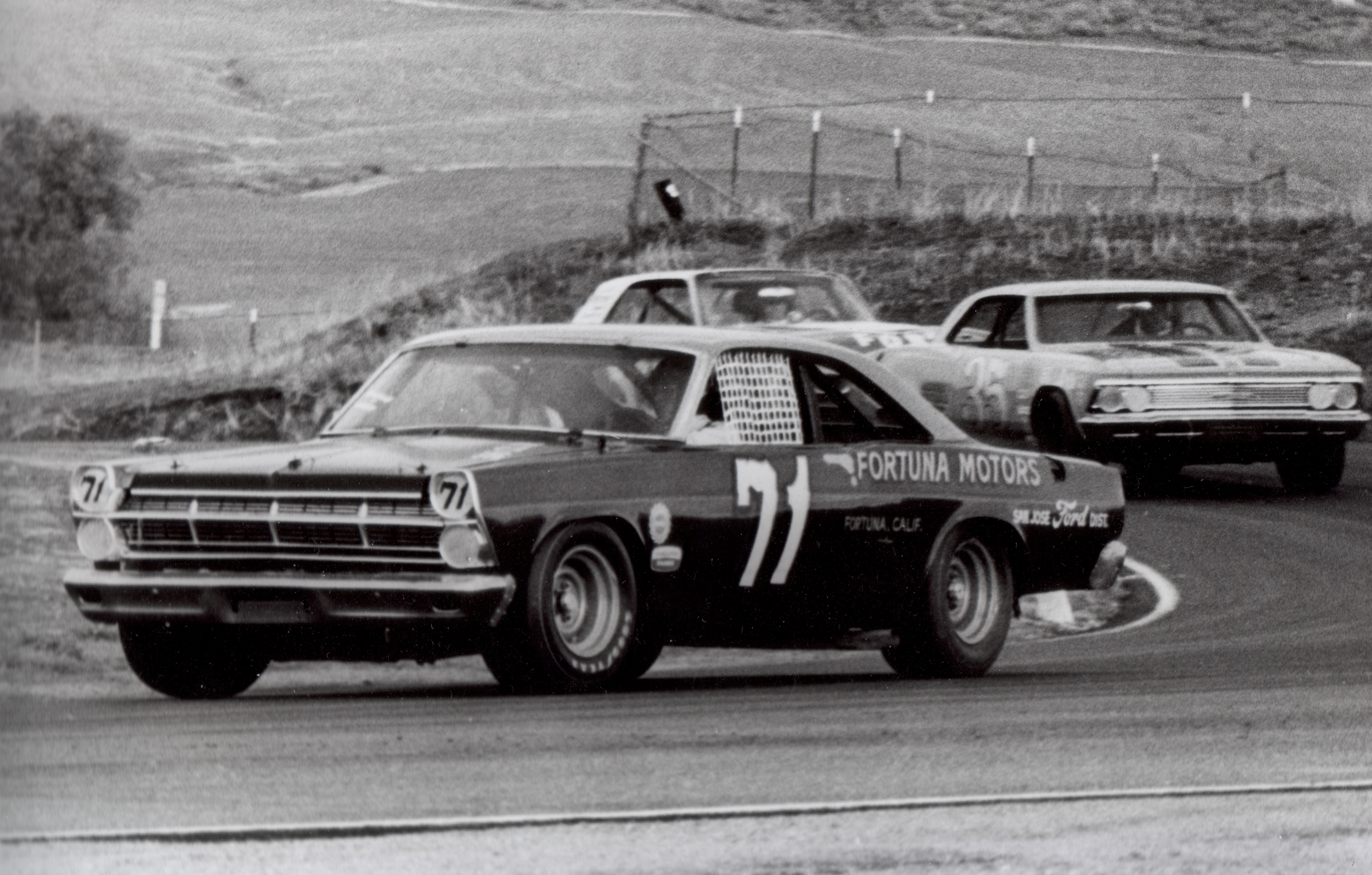
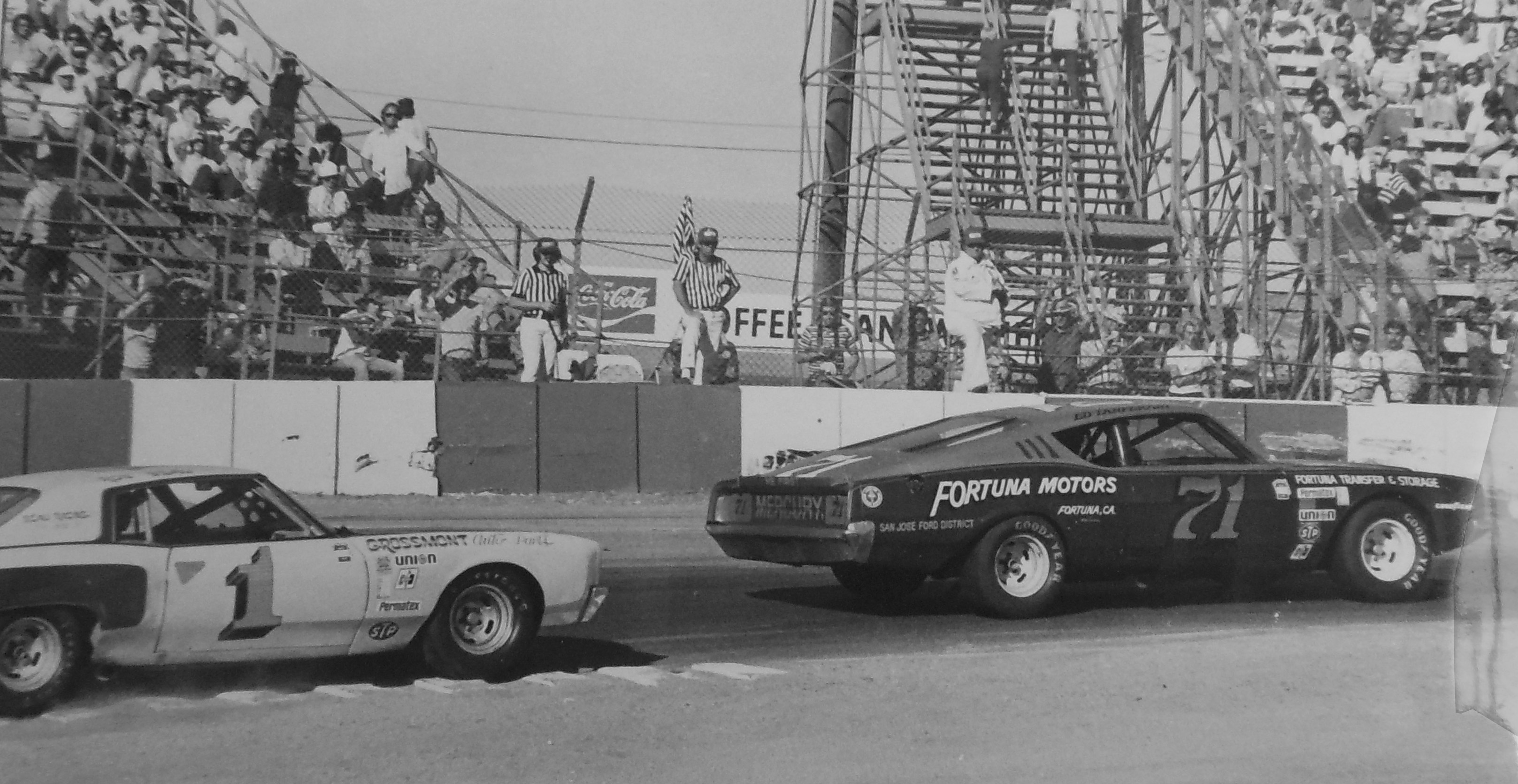
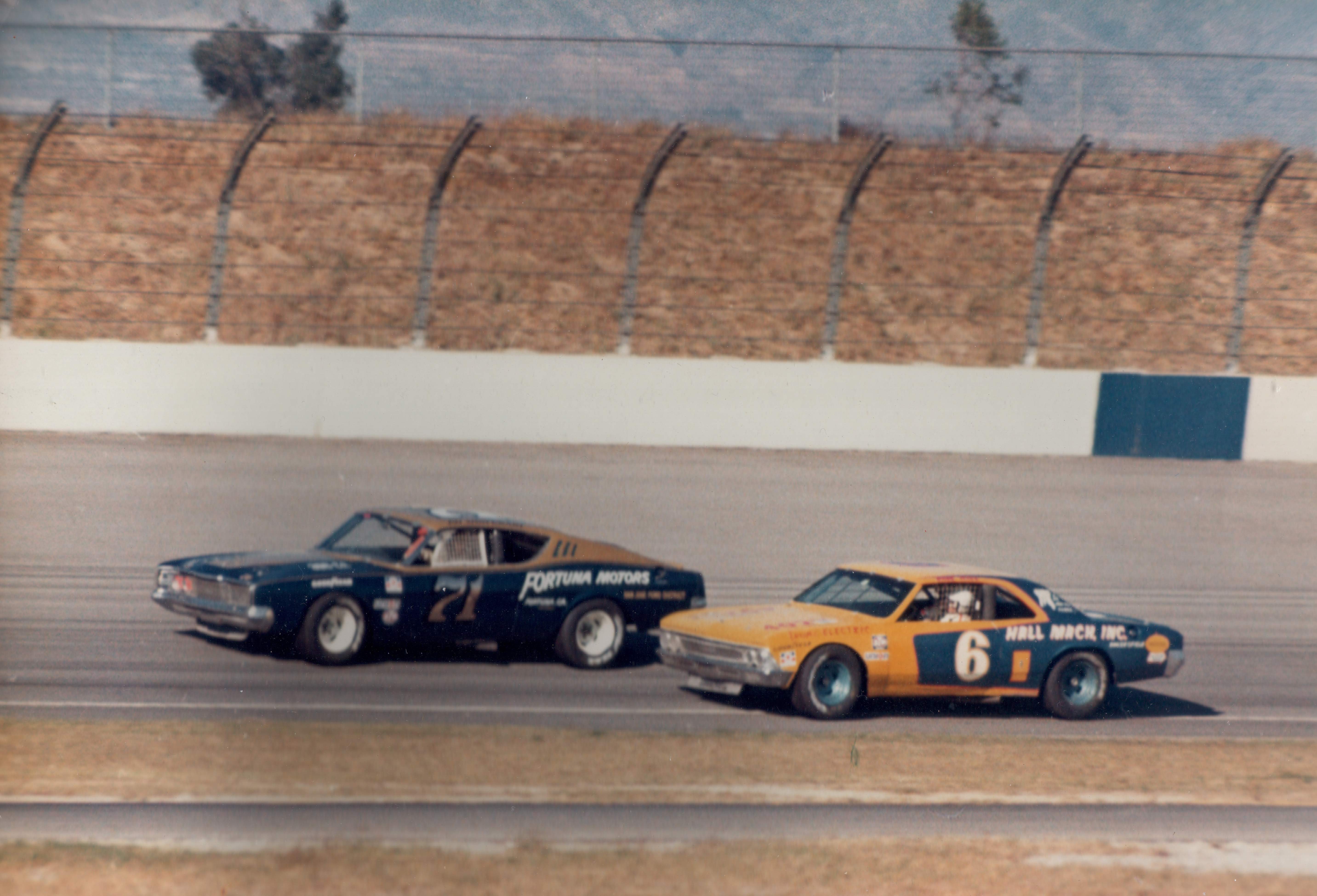
Ed in the ’67 Mercury Cyclone at Riverside
Top of the hill at Riverside
Ed in the Mercury Cyclone at Ontario Speedway
“Don’t spend it all in one place.”
1972 and 1973 Redwood Acres Yearbook photos
Driving a Mercury Comet in the dirt
Following a tangle with Dave McMurray in the Heat race and bad damage, Ed made a high side pass to win the A-Main at Redwood Acres in June 1973.

LEAVING REDWOOD ACRES

From ’65 to ’75 Ed raced in the Super Stock class at Redwood Acres. “I didn’t compete all the time, it was a combination of racing down south for 4 or 5 years, and then I was in the National Guard for 6 years, and so I couldn’t make the races. We’d have a Weekend Warrior meeting of the National Guard. We built this dealership. I was focusing on Riverside and Ontario tracks down south, and then NASCAR opened their rules to disc brakes, and we were running drum brakes, and when they went to disc brakes it was $1400 and I only had $1000 in my whole car. So I had to make a decision, and I decided this is enough, I had a family, onward and upward. And it was so far to go race down there, but it was fun, we met a lot of neat people.”

Ed’s final car, a hard to tame Mustang.

A RIDE FOR RICH KELLER

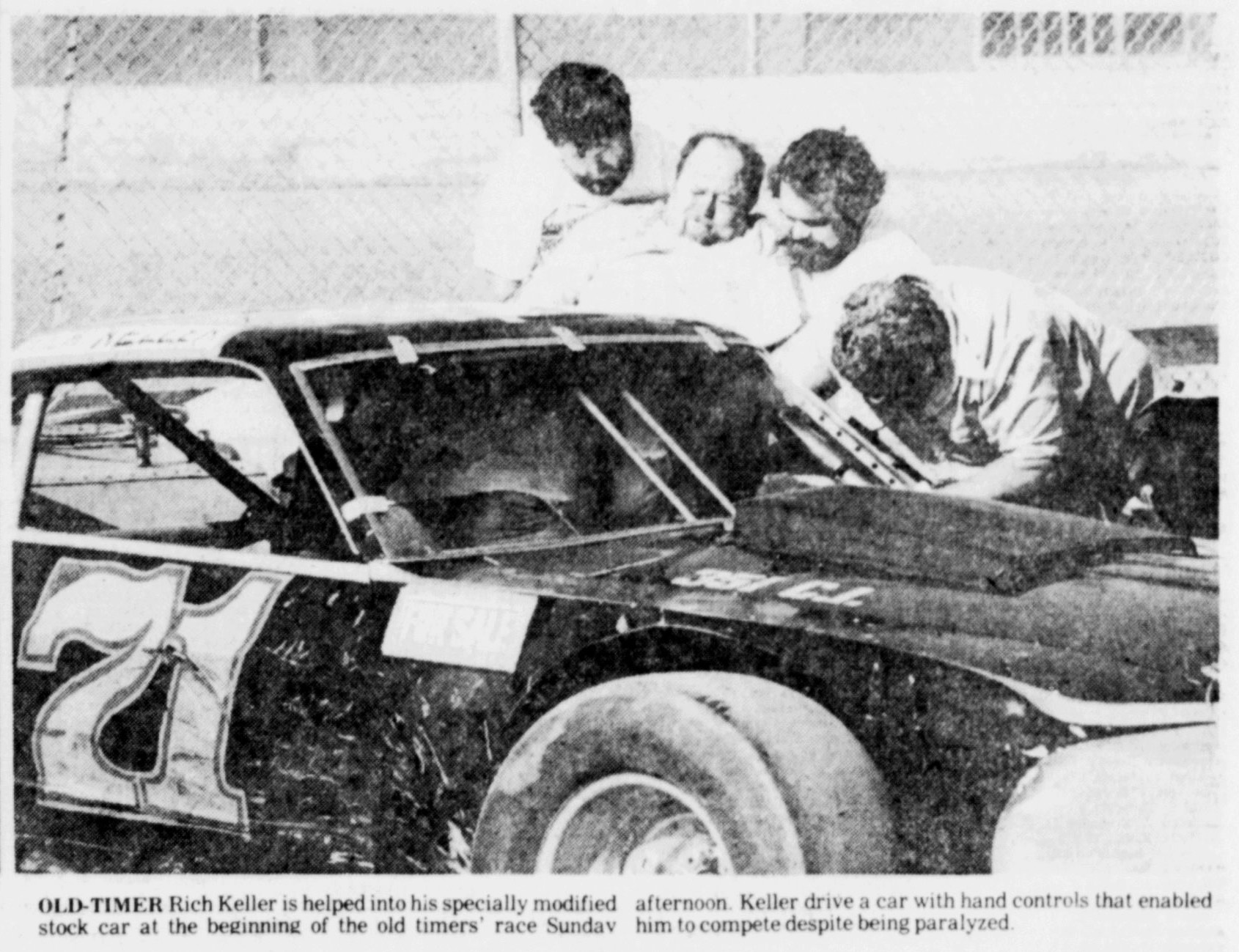
Rich Keller was an early star at Redwood Acres under the SRRA. “He went to Shasta College and started racing with all of us, he was in the mix of it. He served in Vietnam after racing, then came back and was in the Army Reserves, but got a job teaching at Shasta High School teaching Auto Shop, and he was a mechanic all the way through. He was coming back to an Army Reserve meeting over here and something broke on his hopped-up ’52 Chevy pickup; he rolled it and was a paraplegic.”

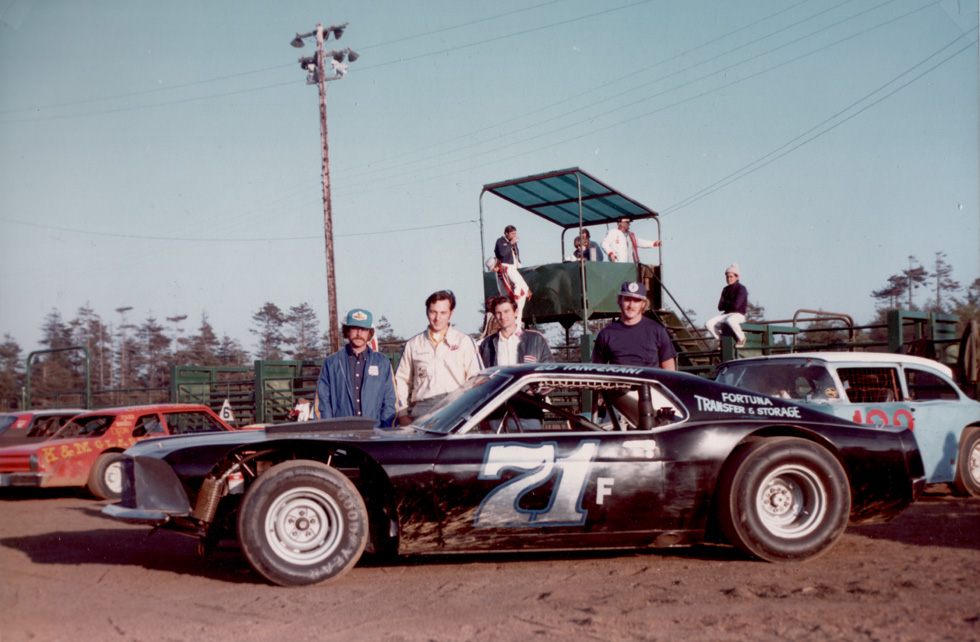
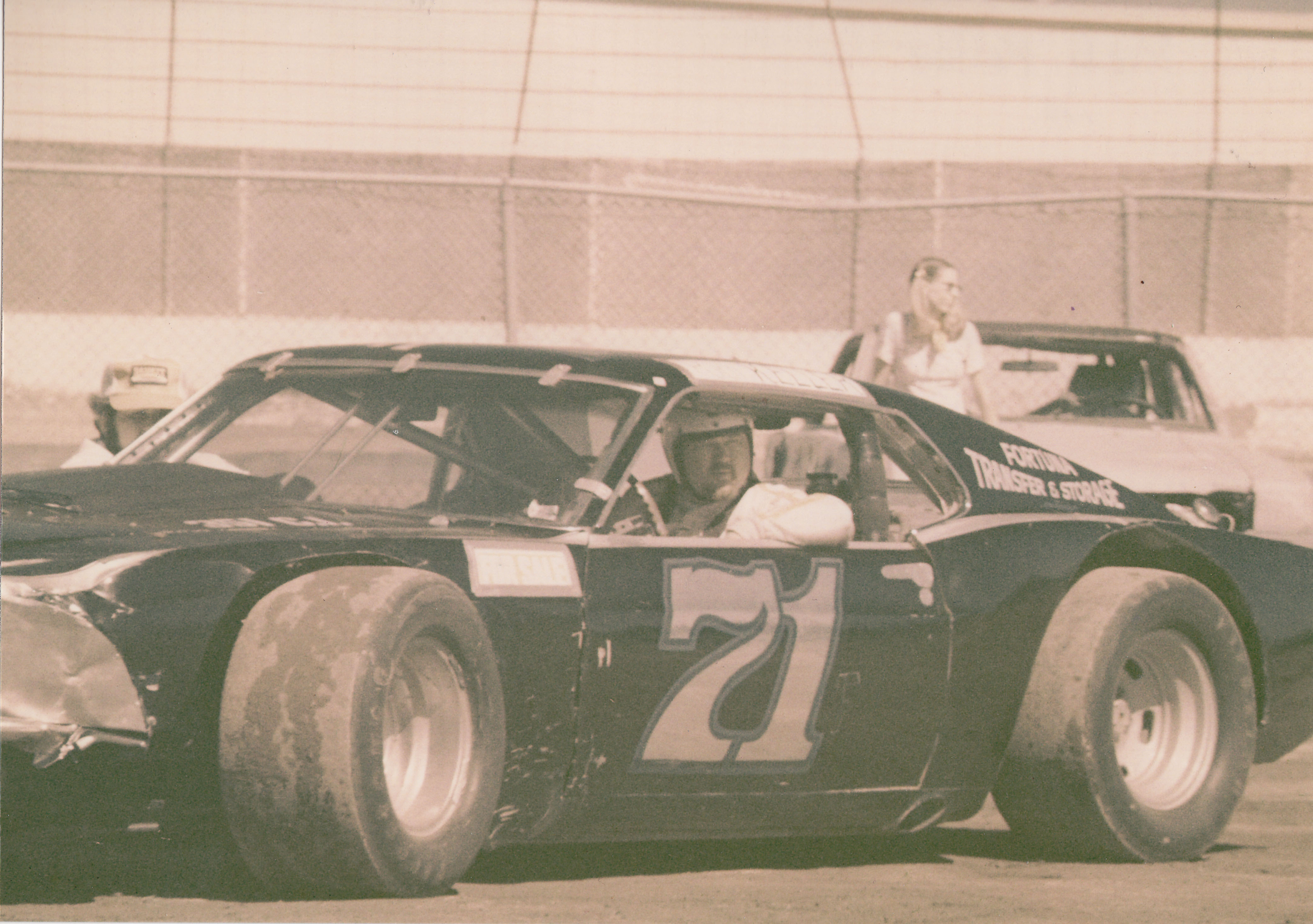
“In the mid-70s there was a ’69 or ’70 Mustang that I was racing that I built from scratch. That was the last car I had and I just couldn’t get that thing to handle. I had it parked, I hadn’t been racing then. And when they had an Oldtimer’s Race at Redwood Acres, I took it into Rudy Zeck’s shop in Eureka, and we worked on it for about three weeks. Rudy and I and another guy in Eureka got some of his hand controls, and Rich raced with us. He had a hand throttle, then we had to put a brodie knob on the steering wheel, so he could steer it with one hand. Changed the brakes and a hand throw on the clutch. Rich always remembered that, it was the biggest thrill.”

Rich Keller in the modified Mustang

RIVALS AND RESPECT

“I think Don Price and I got into it once. So Don kept screwing with me at every race, and I told him ‘Don, I didn’t like how you were racing me’ and I was yelling and we shined each other on but in my mind if he ever messed with me off the track I was going to plant one on him. So we went to Rich Keller’s bachelor party at Vista Del Mar (a sponser of Price) down there by the wharf, and I went to the bathroom and soon as I came out he challenged me and I planted one on him. He was up to no good, he’d been drinking, I’d been drinking I guess,” (Don’s side is he told Ed he was the worst driver out there, Ed popped him, and Don was proud because he still held onto his drink – see his previous article). Ed says Don had a ‘tiger in his tank’ after he fell against he jukebox, others jumped in, and Ed told the heads of the party it was best he left and bowed out.”

Ed says now, “You have to admire him and I do. Because he’s an individualist. He can make it with nothing and make something happen. And as fate would have it, the next week we were both in the Fast Heat at Redwood Acres, Don on the inside me on the outside. My guys said he’s going to want to retaliate, and they dropped the green and I was able to pull him high side, and everyone knew what happened the week before, and he didn’t touch me, he was a man about it. It was racin’. I never did have much to do with him, but I respect him for that. Very much so.”

It’s funny how often in all forms of racing an incident happens one week and the two drivers are right back starting next to each other the next week.

“Rudy Zeck was good. He was, uh, conservative, you might say, because he was on a budget. Wild Bill O’Neill; he always drove like he had a loose steering wheel. I liked them all. Walker, Pries, Bob Britt, Denny Meyers, those were all the first guys out of the hat. We fought, we argued, but at the end of the day we were fine. It was fun, all good guys.”

Ed Tanferani, 2014

Great thanks to Ed Tanferani for his fine hospitality and opening up his racing collection and sharing all the great stories.

FERGY FERGUSON

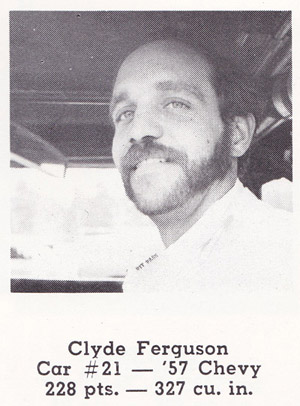
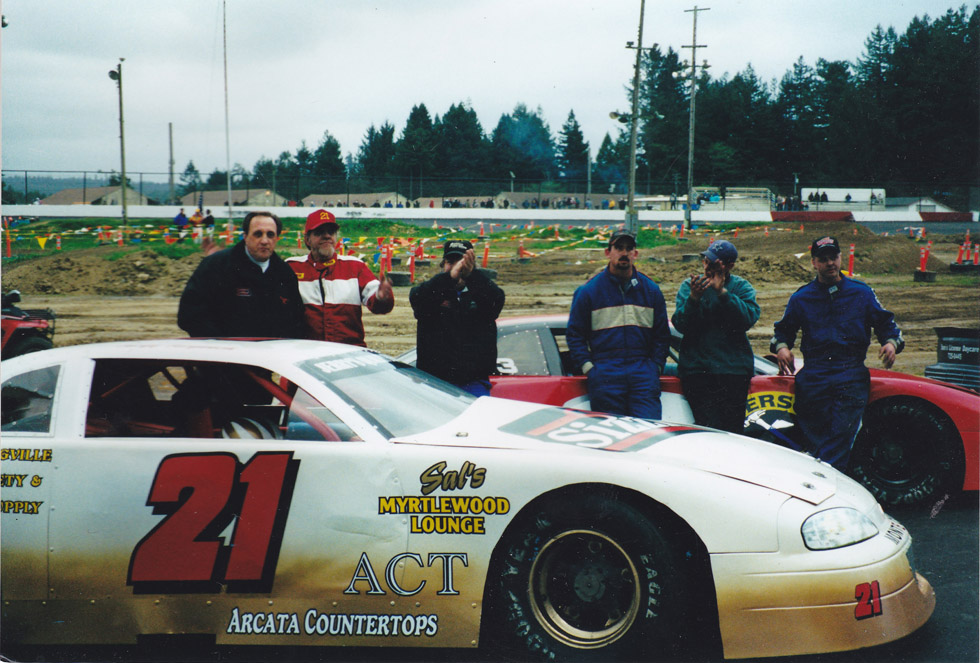
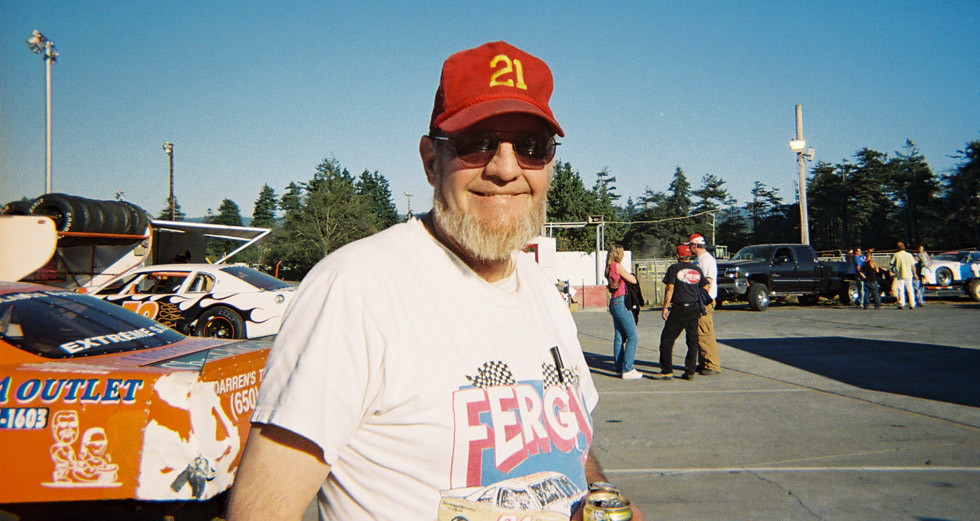
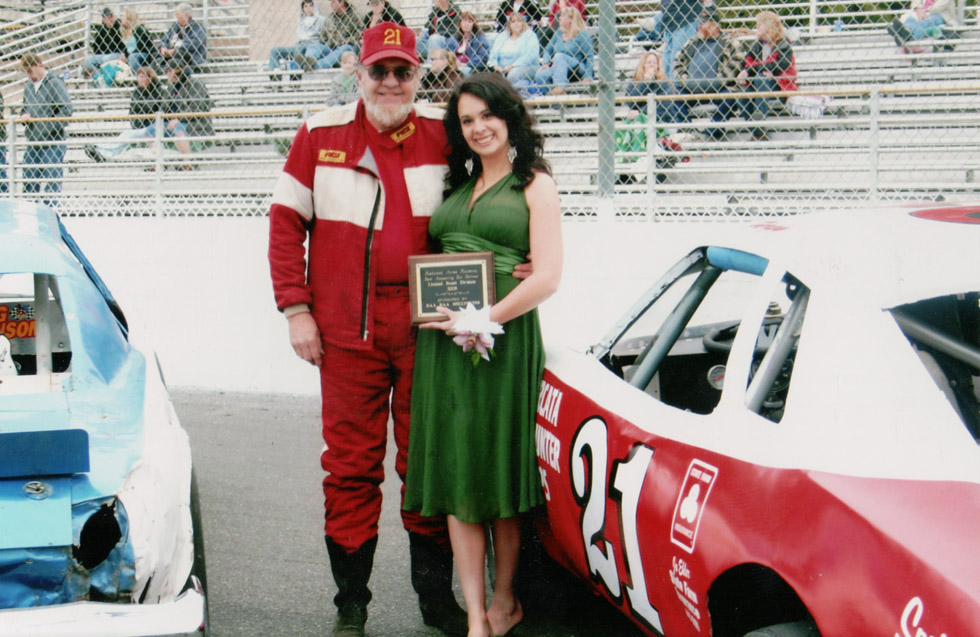
2012 Fall Spectacular 201It is September and Clyde “Fergy” Ferguson is forced to sit out the 2013 season, out of a race car for the first time in 43 years, since his rookie year in 1970, due to needing hip replacements to get back into his Thunder Roadster.  One of a handful of drivers who have been the continual face of Redwood Acres Raceway, his friendly manner and trademark Abe Lincoln beard and low, rich voice, together with his career as a railroad engineer have always given him a salt of the earth appeal, and he has remained a fan favorite at the track who has stood the test of time.

2013 Garage Workshop

“I’m from Eureka, California, born and raised” Fergy says.  “Left here for two years when the President needed me, ’65 to ’67, been here ever since.”

“I worked with the railroad as a locomotive mechanic.  I got severed out in ’69, moved around some service stations, two or three sawmills, until I got another job for the Arcata Mad River Railroad out of Korbel.  They shut that one down but fired up Eureka Southern, and finished my time out there in Eureka.  I was Trainmaster at the end, running the outfit for the last 5 years.  I ran the operations; the scheduling, took care of all the crews.  It was a good job, I liked it.  The thing was we weren’t union, so I could also work on locomotives and engineer, runnin’ a train down through the canyons when a guy didn’t show up.  I could do anything I wanted, I loved it.”

“When I was young, I always liked cars, I was a car guy.  Working on cars, drag racing on the street; I lost my license three times for speeding.  In 1969 old Tim Nelson came to me and said ‘Dick Luzzi is putting another car together and he needs somebody to weld the top back on’ so I went over to his house and welded it on, and I just got involved from there and it just took off.  The racing, I loved it.  From then on I was hooked.  Dick, Dave and Ray Luzzi, they were good competitors.  But that’s how it got me….welding a top on a car.”

1970 Hobby Car Montage

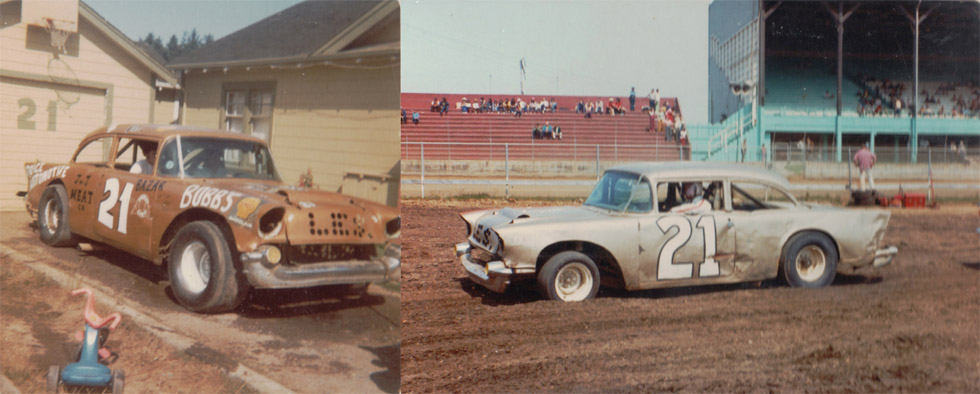
Fergy’s first car in 1970 was the #121 Hobby Stock car. “That was the first Don Price paint job – he ‘laced’ it.” (Shown below in 1971 at the annual Rhododendron Parade in Eureka)

1971 Rodie Parade

1972 Clyde Ferguson SRRA Yearbook

1972 SRRA Yearbook

Racing in the old dirt days had its share of stories.

“One race Casey Dungan lapped us all.  Matt Kunkler got so upset he just gave up, so I passed him.  I was runnin ahead of him and we had a yellow come out, and he decided he wanted to get it back.  We drove down the main straight and I knew what he was doing, he was going to use me as a bumper going into one,  so I hammered the breaks and he went right past turn one and right off  the track.  There were no walls back then.”

“If you talk to Angelo Marcelli, ask him about the Suitcase Race”, Fergy says, standing in his living room looking down at his feet, dropping the hint of a good story to be told.  “We raced around the track, stopped, got out, then opened an old suitcase full of women’s clothing that we had to put on before getting back in and racing again.  Angelo won but he cheated; while I was taking time to pull on the pantyhose, he was shoving his legs in and ripping them apart.  He didn’t care how they looked.”  There was no comment about who might have had the edge in experience in such a race.

Another race Fergy recalled was the time Medford’s Tom Wyatt won the A-Main but was disqualified, managing to stay out in front of the rest of the field in spite of driving on three wheels.  “He was black flagged. Broke the lower ball joint, so he’d go through the turns and it would set it back up, but then down the straight it would lay back down again.  I think it was a ’57 Chevy too.  Dane Smith used to come down here and race too.  He was really fast.  He was a helluva dirt racer.  He just won everything on the dirt.  All those guys loved Redwood Acres.  They all really enjoyed coming down here.  It was bigger and it was fast.  The big track, not the doughnut.”

By 1972 Fergy was racing in the Super Stock division, and the search for the perfect gold paint job had begun...

By 1972 Fergy was racing in the Super Stock division, and the search for the perfect gold paint job had begun…

Fergy at Anderson near Redding, CA 1973

Fergy at Anderson near Redding, CA 1973

“I didn’t do a lot of out-of-towners, I went to Placerville with the first Super Stock I got.  I bought John Morrison’s ’57 Chevy.  I went to Redding a couple of times.  Never did get the gear ratio right for running on asphalt. They were dirt in the early years but they asphalted real soon.   I went to Medford with the ’57 and turned fast time of the day up there.  It was unbelievable.  I went out and qualified, came in, I got out of the car and was walking and I hear sssssssssss and the air was coming out of one of the tires.   I had run over something.  I didn’t bring any spare tires, that was just what was on the car.  So I pulled the tire and ran it down town to see if there was someone who could patch it.  I  found some service station that would fix it for me and when I finally got back the guys were waiting for me and they said “Get in the car!”  I said what do you mean get in the car, ‘You get in the car, you’re in the dash!   You turned fast time!’  I said c’mon quit kiddin me. ‘No get in the goddamned car you’re in the dash!’  So I got in it and couldn’t do anything, they just beat me to death, I brought that car back and every rim was bent and the bumpers on both ends, they just tore me up.  And I lost the clutch during the main event too.  It was quite an experience.  The dirt was similar to Redwood Acres, it had a little cushion to it.  Quarter mile D-Shape and had a little tiny short straightaway; a turn all the way around.  I just took the green, put my foot on the floor and let it hang out all the way around, never let it off.  Beat all the fast guys, old Jack Keck, Tom Wyatt, all those guys were there.  I actually turned faster than all those hot shoes. That was the highlight of my out of town career there”, he says laughing.

1973 Jerry Carter and Fergy FergusonFergy has fond memories of Jerry Carter – driver and then flag man at Redwood Acres, who also put together the weekly race program, the Stock Report:  “We were racing in the main event, I come off of turn four, and everybody was slowing down, so I just went to the outside and I was going down the wall then I realized what had happened- Jerry Carter had spun on the inside, and came back across the track and parked it backwards right in front of the flag stand, and I’m coming full boar down the straightaway and I thought I was going to kill him.  I reached up and grabbed the wheel and snapped to the left and I went sideways and I took the front end of his car off, straightened it back out, and kept on going.  That was one of my scary moments because I thought I was going to T-Bone him.  I was wide-open.  I think it bent my fin a little bit.  But I was still able to race.”

“I thought he was a good flag man, myself.  Of course I thought most of the flag men were good, and everyone else hated them.  There’s no doubt it’s the hardest job.  No matter what you do, you are going to offend somebody.”

(Both are pictured at right in the 1973 SRRA Yearbook)

1973 74 SCAN0028 Don Price mix paint job

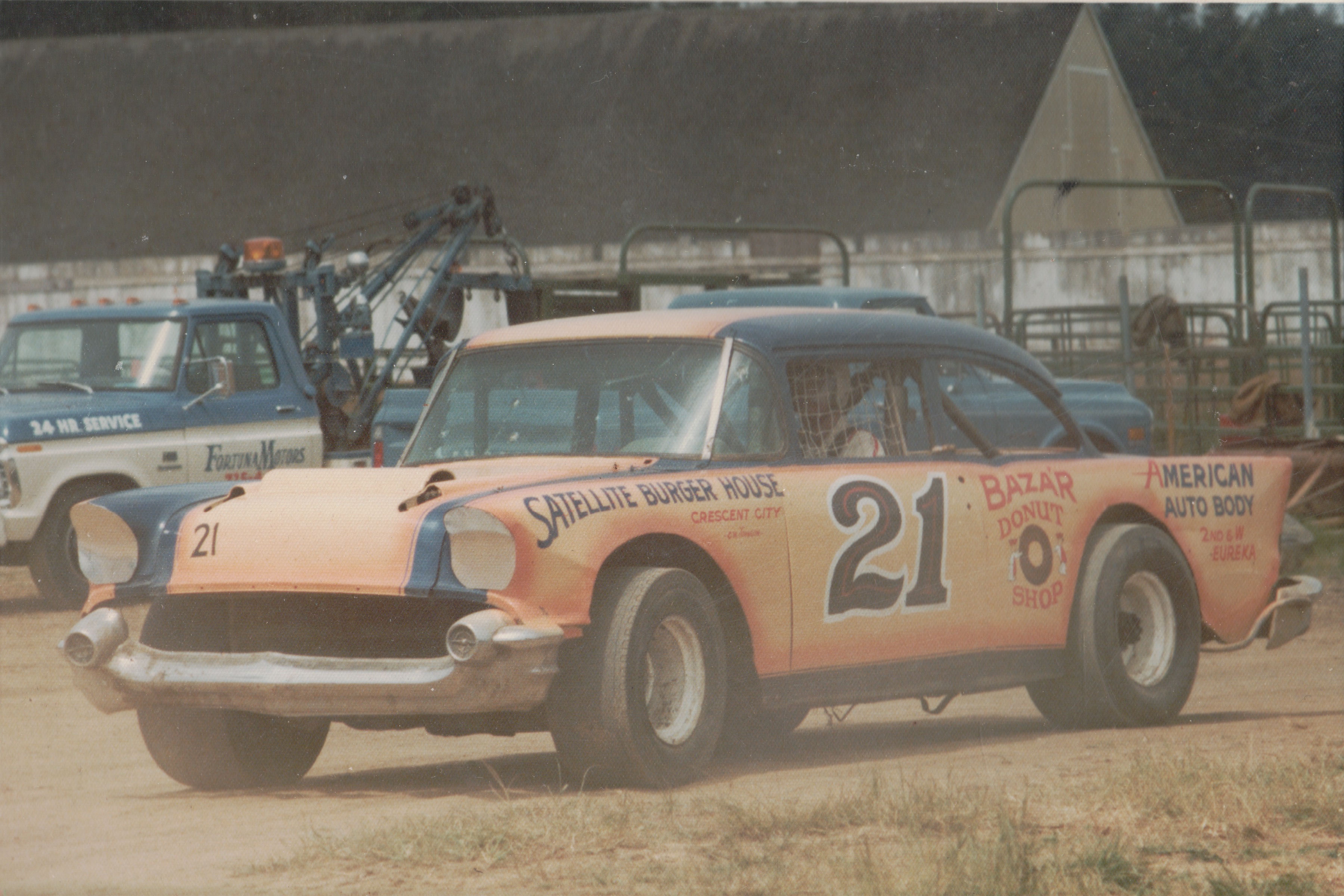
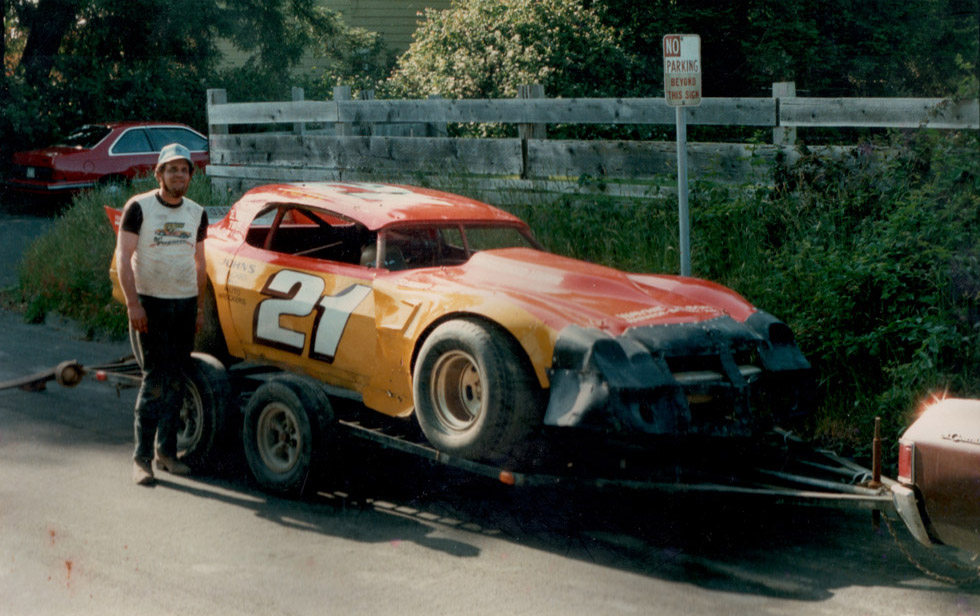
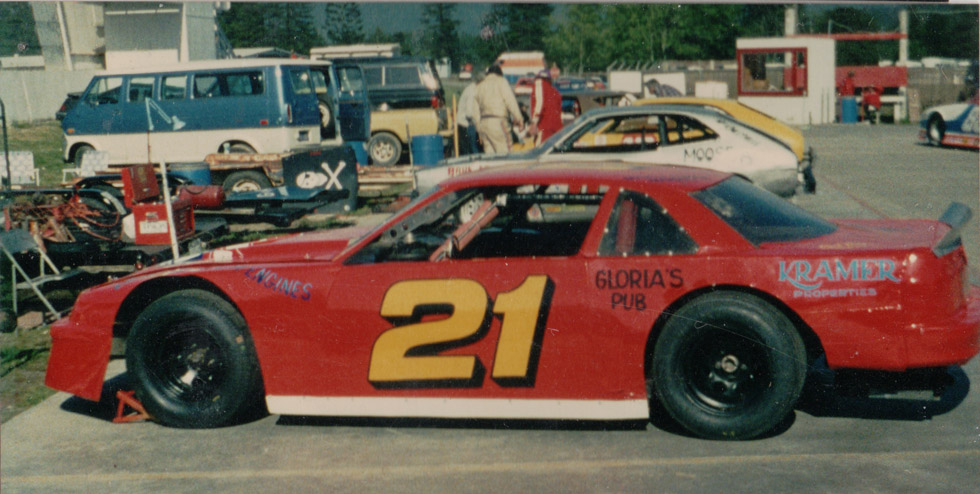
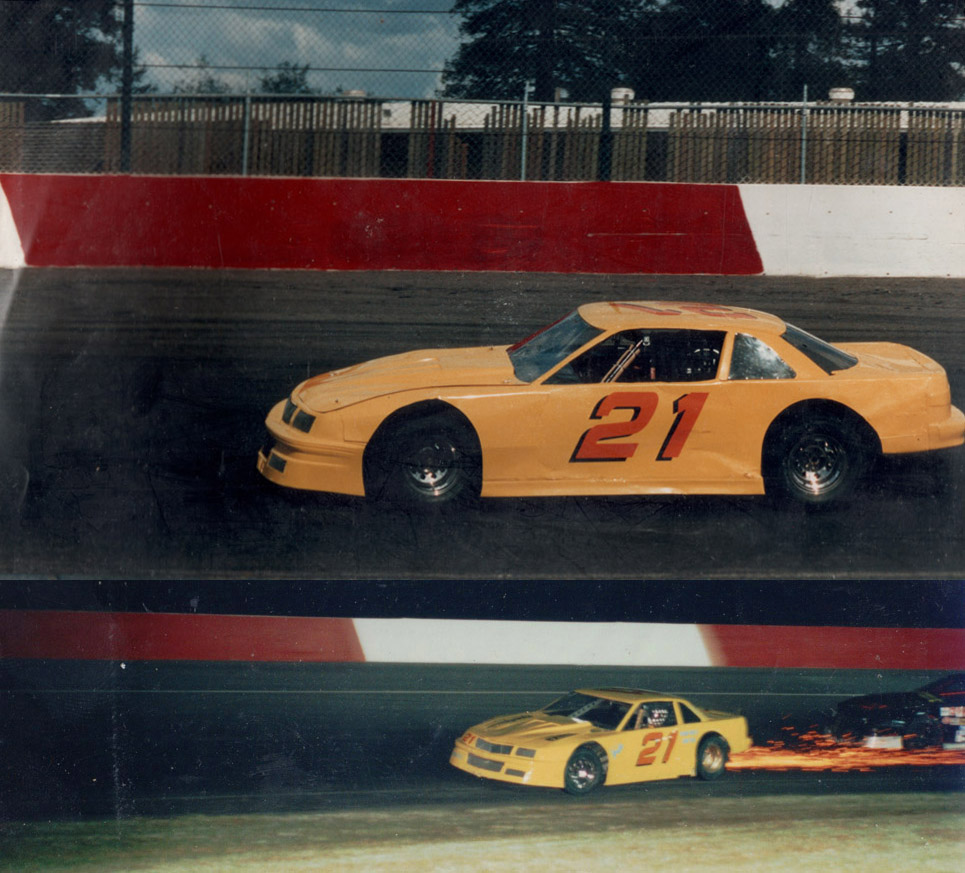
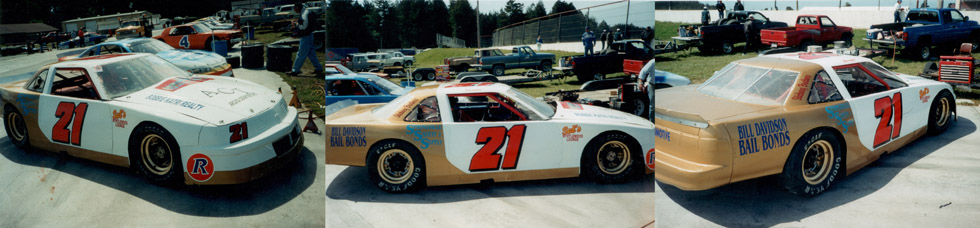
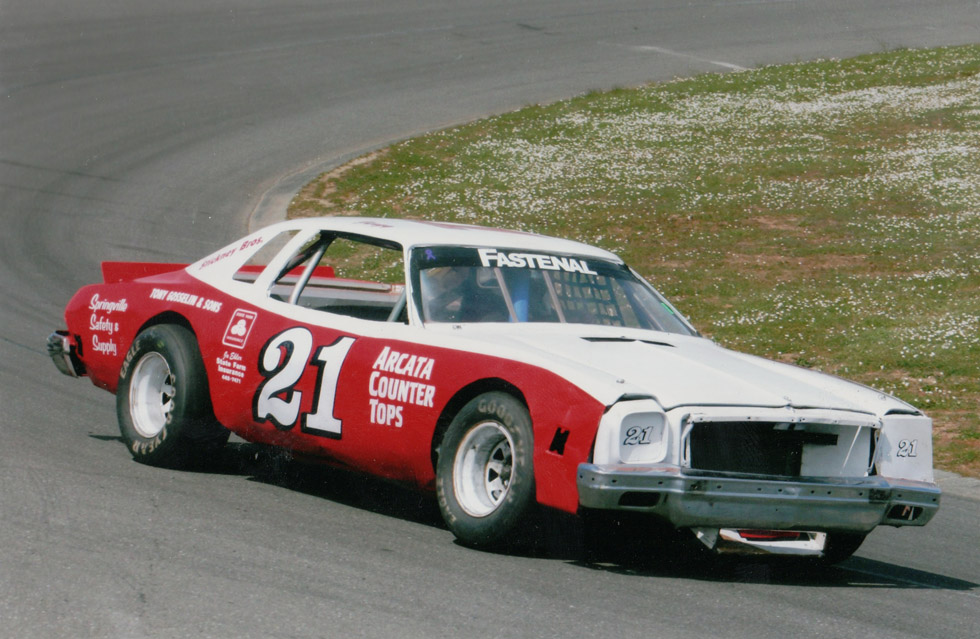
In ’73 or ’74 driver Don Price painted Fergy’s #21 Super Stock car using whatever paint he had in the shop. “He started pulling paint, whatever he had leftover, he started mixing up stuff and shooting it, and that’s how it came out. That guy was amazing.”

Fergy has lived in his current home in Eureka for 30 years; approximately one mile doorstep to start line from the track at Redwood Acres Fairgrounds.  Before that he lived on Marsh Road by radio station KINS.  “Didn’t have far to go with either house.  I kept myself close”.

“One night after a race I drove my race car home from Verla’s Pizza House out on Myrtle Ave.  We towed it on a chain, and the guy that was towin’ me took off and didn’t come back.  And after having some beers and pizza and all that, I said well what the Hell, jumped in it and drove it home.  It was crazy.  I didn’t have to go that far, luckily.”

Fergy and crew 1975

Fergy and crew 1975

Racing at Redwood Acres at that time was governed by the Six Rivers Racing Association, with many of the drivers as board members, including Fergy.  “I was on the board for about 5 years or so.  I was Vice President, 2nd Vice President, then President after that.  My wife Ann helped as VP.  The VP’s job was to get trophy girls, and Ann took care of that, standing in as trophy girl herself at one time.  She won Best Legs in the Hot Pants competition too.”

“We used to say each car in the pits brought 5 people, at a minimum.  So the more cars you can field, the more people in the pits or in the stands.  Start another class- more cars meant more people   At one time we’d have 130 cars, all in the infield, at least two or three classes.  When we’d have an open, we’d have C and D Mains even, 150 cars.”

“I tried being impartial as the president.  No Qualify –  No Race.  Ed Tanferani came in late, told him ‘don’t even unload it’.  A special board meeting took place in the middle of the track and overruled my decision and they let him race.  Overruled the rule book.  He was the big hot shoe, what do you mean he can’t race!  I stuck by my guns.”

“Everyone was supposed to pack the track, get their car out there, a lot of the hot shoes didn’t want to get mud on their cars.   You were supposed to pack the track, get it out there.  You watered it, even though it was ‘dry slick’ it would still slick out.   The guy who was filling in on preparing the track for a while would put dried cement in the turns.  He’d come out with bags of cement and sprinkle it in the turns, then water it, he was tryin’ to make it hard.    He wanted it dry slick, he definitely got there.”

Fergy loves reading about drivers from the old days.  “There’s always the ‘gray areas’ in racing.  Smokey Yunick and his two inch fuel line snaking all around the inside of the car, zig-zagging and holding an extra 5 gallons of gas.  He was an ‘Innovator’.  Smokey Yunick was the best, he did all that stuff.   Drilling out holes in sealed parts to make them lighter, wrecking the car and building it back with a  cut roof.  The Innovators – they like to play in the gray.”

As with any local short track, Redwood Acres had its share of characters and fine racers.  “Hank Hilton;  he was a good old boy, Hank.  He enjoyed his racing. Crazy Mitch Gilbert- The One-Armed Bandit. Don Price, Larry Pries, (Jim) Walker, I got along with all of them.  Jimmy was a good racer.  He won the Rose Classic a couple of times.  He was a good shoe. Pries ran good at Riverside too, so did Don Price.  I always told everybody if I could be as aggressive as Larry Pries and as smooth as Jimmy Walker, I could win everything.  I used to watch Larry going into the turn and everybody let off and he’d jump in there two car lengths.  Oh man, he was an animal.  He was something else.”

1976-79 Fergy and Car in  Pits

Fergy raced the classic Shakey’s Pizza ’57 Chevy from 1976 to 1979, he’s shown above wearing the mandatory white pants in the infield pits for safety and the Firestone windbreaker with racing stripe for promotion and all-around coolness.  The ’57 Chevy was a common car at the races back then.  “Now you kick yourself in the ass for tearing them up” he says.   “I bought one in Fortuna for 35 bucks- it had one dent on it on the fender, had all the checkerboard on it, all the chrome, everything was just beautiful.  I ripped all that stuff off and made a race car out of it.  And now you say to yourself ‘If I had that now it would be worth $75,000!’   Cut them all up, make them race cars.”

1976-79 Car in  Pits SCAN0026

New Tire - Stock Report

Photo and caption in the Stock Report

“In the Stock Report Jack Clark wrote an article on me saying ‘Don’t leave the lid off your garbage can because Fergy will come around and steal your leftover parts.’  I’d go by Casey’s and take all the stuff he took out of Ken Wallan’s motor and put it in mine.  They were already broke in”, Fergy says, laughing.  “I had one motor where everything was used- I think the only thing I had money in was the head gasket and the oil.  I figured out I had $64 in the motor.  It ran like Hell too.  I put some stuff together, they blew up too, but that was the fun part about it.  We’d go out there and run with nothing.”

One of the great things about short track stock cars is seeing the dents and damage patched together as the season rolls on.  “I had put a gallon of bondo on mine, I already had a gallon or two on it, just to make it look good.  It ended up looking good but if you hit it the whole side would have fallen off of it.  That’s what I told the guys- don’t hit me too hard, my whole side will fall off!  It’s all bondo!”

Transforming "Thumper"; note mechanic at work on left (Ferg) with four supervisors on the right.

Transforming “Thumper”

1981 Limited Main Winner

1981 A-Main Winner (The Stock Report)

Ed Rassmusen was a drag racer who in 1976 put together a  blue #50 ’69 Camaro known as “Thumper” to race at Redwood Acres.  Thumper made an impression, and Ed won A and B mains during the year and finished 6th in the Super Stock points as a rookie.  In 1979 Fergy bought Thumper and turned it into an orange #21.  In 1981 Fergy would win the track championship in the Limited Sportsman Division with that car.  “We did good with that thing.  I won everything.”  But as often happens on local tracks when one driver wins most of the time they become the villain, even the popular Fergy Ferguson.   “The year I won the championship was the only time I ever got boo’d”, Fergy says.   “That’s just the way if is.  They told me I shouldn’t be running in that class and I didn’t belong in that class.  I didn’t have any money in it.  I never had any money in any of my cars.  That year was my year. ”

#21L Limited Sportsman ready for the Rodie Parade.

#21L Limited Sportsman ready for the Rhodie Parade.

In 1982 Fergy ran the Champion's #1, but if you looked closely there was still a tiny "2" in front of it still.  He finished 3rd in the Limited Sportsman points that year.

In 1982 Fergy ran the Champion’s #1, but if you looked closely there was still a tiny white “2” in front of it. He finished 3rd in the Limited Sportsman points that year.

1982 1L Limited Sportsman on trailer1982 1L Closeup

In the early 1980s Redwood Acres Raceway was still a dirt track, but drivers ran asphalt setups on it and slick tires.  While you could leave the area to run on paved tracks easily, the true dirt cars set up for clay did not exactly work here.  “When Ron Peters first came over to go racing here he came in and pitted pretty close to me and I introduced myself” Fergy says.  “I looked down and seen the tires he had on and I said ‘Ron, I hate to tell you this but you can’t run those dirt tires.’  He said ‘What do you mean, it’s dirt aint it?’  ‘Well, not really, it is dirt but its not; we run these asphalt tires.’  ‘Dirt’s dirt’ he says.  He went out, went down the front chute and went out the end, came down the back chute, went out the end, went around a couple more times and kept going off the track, came in the pits and said ‘Well Ferg, I guess you’re right.  These things dont work.'”  (Ron evidently saved those tires for when the clay was later added because he became Track Champion.)

“I don’t remember how it got determined to change from a dry slick to a good clay track.  In the meetings we thought that was the direction to go, was to get some really good sticky clay on there and make it a real dirt track.”

“We hawked our ass for that clay.  Everyone signed for a $10,000 note to put that clay in.  And man that was the best thing that ever happened.  We had the fastest dirt track on the west coast, it was just animal.  Guys were pulling the front end off the ground as they went down the straightaway.  They stuck like glue.  You’d walk across it and you’d pull your shoes off, it was sticky shit. ”

1980s Dirt Car SCAN00441980s Dirt Car scan00002

Mid-1980s dirt car for the clay track at Redwood Acres

Late-1980s dirt car for the clay track at Redwood Acres

Portrait of a driver overcome with nervous anticipation

Portrait of a race driver overcome with nervous anticipation

1988 Trans Am

1988 brought a newly paved track and a Trans Am asphalt race car

In 1988 Rich and Linda Olson took over promotion of the track and it was paved with a wall added from turn one all the way around the track, with the intention of luring NASCAR races and therefore more fans and more money to the fairgrounds, thus ending the Six Rivers Racing Association.  “It was over, we were through”, Fergy says now.

“It scared me to death when I came out the first time on asphalt.  There was a wall all the way around, you couldn’t get out.  It took me a while to run up against the wall.  It was scary as Hell.”

After initially racing a modern Trans Am race body on the newly paved track, in a real old school move, when other drivers had moved to lighter aluminum and fiberglass,  Fergy decided to buy a Chevy Nova from the Street Stocks and run it in the Super Stocks division.  And in keeping with his Lucky 21, the car was already running his number on the side when he bought it, just waiting for him.  He raced it in the original red and white colors before painting it his trademark gold.  “I bought it and put a motor in it, ran it in Late Models.  I had a good time with that Nova.  Everyone had gone to plastic front ends.  That Nova was still steel.  Called it ‘The Dinosaur’.  I put a quick change on the back of the automatic transmission so I could get the ratio I wanted.  They said the 10 bolt rear end wasn’t heavy enough to run, but I did it.  The thing was crazy.  It was a good car, had a lot of fun with it.  It was all steel.  Geoff Neely asked ‘What you got underneath that doggone Nova?  You’re liftin’ the left front wheel off the ground.’  I said ‘No wonder that sumbitch don’t handle through the turns!’.  But man it took everybody down the straightaway.   Geoff was a good racer.  He ran good.”

'The Dinosaur'

The evolution of ‘The Dinosaur’

Fergy would trade his Trans Am to Crescent City Late Model driver Howard Ford for a Chevy Lumina.  “I had a car that I was trying to race and it wasn’t working out, so I traded in that because he wanted the front end from that, and that is where the Lumina came from.”   The cars over the years would change but the colors generally remained the same- always the #21 and a variation of red and gold colors.

Fergy’s cars often won Best Appearing Car at Redwood Acres Raceway.  “In the early years I had Don Price paint them for me” Fergy says.  “Don did all my paint jobs on the dirt.  In the later years I painted them myself, and my son painted one or two of them for me.  When we went to asphalt I started painting my own cars and creating my own paint schemes.  I was always trying to get the gold, never did find the right color until late.  Finally found the bright gold I’ve been looking for for years.”

“Always trying to get the gold…”, his voice sounding like an old prospector.

Lumina SCAN0052

The Hit Me Red Lumina as Fergy called it

Lumina 1Lumina three panel

Fergy's #21 KEKA Chevy Lumina lined up next to Tim McCracken followed by Wade Lentz, both from Redding.  Tim would finish Sportsman Track Champ, with Fergy 4th in points.

Fergy’s 1997 #21 KEKA Radio Chevy Lumina lined up next to Tim McCracken followed by Wade Lentz from Redding. Tim would finish Sportsman Track Champ, with Fergy 4th in points that year.

The 2001 Sizzler Monte Carlo was Fergy's favorite paint scheme, designed by his son Nick.

The 2001 Sizzler Monte Carlo was one of Fergy’s favorite paint schemes, designed by his son Nick.

Fergy's first race at RAR after a layoff in 2004

2004: Fergy’s first race at RAR after a brief layoff

Fan Appreciation Night at Redwood Acres 2004

Fan Appreciation Night at Redwood Acres 2004

Quality Time with Family & Trophies:  daughter Leslie in 1982 (left) and early 1990s (center), grandson Dylan in 1997 (right), and with wife Ann in 2005 (below) on a night Fergy was thoughtful enough to win a race for her on their wedding anniversary.

2005 w Ann win on anniversary

Fergy enjoying the sun in his vintage Fergy shirt in the pits after the Fall Spectacular 2005

Fergy enjoying the sun and a beverage in the pits after the Fall Spectacular in 2005

Limited Street SCAN0068In 2006 Fergy joined the Limited Street Stock division, a class of vintage muscle cars with wide tires and lots of power, they were a faster alternative to the Real Stocks and became nearly as fast as the Sportsman.  They were cars after his own heart- more like the old Super Stocks in the 70s, a link to his racing past.  And to cap it all off, he came up with a paint scheme that was a throwback to the old Wood Brothers Grand National cars.  But the struggling car class soon went away due to dwindling car counts.  With drivers migrating in and out of classes, one goes up and others go down, an ongoing story at local tracks. “Every class they had they escalated out of what they originally were, the pure stocks escalated so far so they had to then start over as Real Stocks.  This has gone that way for years.”

Limited Street SCAN0072

Winning Best Appearing Car for the Limited Street Stock

#21 Thunder Roadster at the 2012 Fall Spectacular at Redwood Acres

Fergy’s beautiful Thunder Roadster at the 2012 Fall Spectacular at Redwood Acres

The ‘Thunder Roadster’ was designed by Charolotte Motor Speedway director of research and development Rudy Zeck, who also happens to be a two time Redwood Acres track champion.  Much like Legends and Bandoleros, they are identical “spec” cars with sealed engines designed for close racing.  Visually, Thunder Roadsters have the look of the Indy front engine roadsters of the 1960s.  When introduced at Redwood Acres around 2006 they caught on with returning track veterans like Ken Wallan, Dave McMurray, Bill O’Neill, and Nyle Henderson.  Some had not been to the track in 20 years or more.

“I decided to go to a Thunder Roadster instead of a Sportsman because they are a lot cheaper if you tear them up. The initial cost isn’t cheap but they are fairly easy to maintain.  The economical thing is that if you actually wreck it they are breakaway parts;  aluminum struts and joints where all the front end geometry is – you just replace it, it’s very low cost as far as that’s concerned.  They’re fiberglass, you don’t completely destroy them.  I hit the water barrels and took the nose out, the left side of the car, and I think it cost me 500 bucks.  If it was a Sportsman it would have cost me three grand, at the low end.  It has a sealed engine- the motors are spec and one shouldn’t be faster than the other…but they are.”  He repeats with a wry tone for emphasis, “But they are.”

“It’s very frustrating, I’ve always been used to running up front and now I can’t keep up with the fast guys.   It’s a momentum type car, you have to get into the turns and get through them quickly.  A lot of it is those young guys have no fear.  They get up on the wheel, they go.  A lot of that has to do with my age.  I’m probably a little more cautious than they are; I’ve hit every wall out there.  When I was younger, I got after it too.”

Among the trophies rests his first racing helmet, purchased for $14 in 1970.

Among the trophies rests his first racing helmet, bought for $14 in 1970.

“I’ve had a good time most of my time racing”, Ferg says.  “Back in the day, back on the dirt, I threw motors together right and left, just to go.  I built the motors myself, did everything, it was pretty simple on the dirt. I’ve never really had a bundle of money, but we always could compete.”

2012 Fall Spectacular 199

In the pits following the season finale at Redwood Acres 2012

My thanks to Fergy Ferguson for welcoming me into his home and sharing his great collection of photos and stories from his days in the Six Rivers Racing Association racing The Acres.  We talked about doing this over the years and it was great to finally make it happen for real.

2012 Fall Spectacular 200